Sunday, May 13, 2012

Travis Rogers' Review and Jason Crane Interview

Me playing at Ivories on Friday
Some people never seem to shut up about themselves. I'm one of those people. At least my blog persona won't. Anyway, we had a good show at Ivories on Friday night. My concerts are rarely reviewed, so here is a link to Travis Rogers' blog where he reviewed the performance. I like Rogers' blog because it's honest and from the heart. It's very unpretentious and to the point. Rogers' blog deals with many other philosophical subject besides music; I'll have to take some time to sift through it. But I'm always glad to get positive feedback from someone who is knowledgeable.

http://travisrogersjr.weebly.com/index.html

Jason Crane
If you want to hear more about me and how freakin' great I am(crickets..........), check out an interview I did with jazz journalist Jason Crane. He has a great site called The Jazz Session. He has done hundreds of interviews with jazz greats. He's a cool guy and knows the music well. He's also a prolific poet. This interview was conducted back in April, before my show at the Jazz Standard in New York. It was pretty loose and candid. I felt comfortable and tried to "keep it real" as much as possible. Check it out, and then check out some of his other interviews.

http://jasoncrane.org/

There are so many jazz blogs out there already, I'm surprised that anyone takes the time to read mine. I think most blogs are more interesting and valid than the so-called "jazz mainstream press." When you take the advertising concerns and the politics out of it, I think it ends up being more about the music than the hype. You can't listen to hype. Hype can't move you the way music does. You can't dance to hype. No married couple ever said, "Listen, honey....they're playing our HYPE!"

Friday, May 11, 2012

George Colligan Quartet at Ivories Tonight! Live Recording!

I'll be smiling if you come to Ivories tonight!
For those of you who live in Portland, you are in for a treat; tonight at Ivories(1435 NW Flanders) is the George Colligan Quartet. I'll be playing piano, and maybe some melodica if I feel like it. David Valdez is an amazing alto player, Eric Gruber is an amazing bass player, and Todd Strait is a killing drummer. (Killing means he sounds great, not that he has ever killed anybody. That I know of.) We'll be playing a lot of my original music, as well as some off the beaten path jazz standards. We are doing a live recording, so if you want to be documented on our recording, prepare your hands for clapping and come on down. It's a 10 dollar cover; Come on, it's worth it!


I leave you with a video of me playing with Al Foster, Eddie Henderson, Doug Weiss, and Eli DiGibri. This was recorded in Paris in 2007. Enjoy!

Thursday, May 10, 2012

Thoughts On Sight Reading and So Forth

Mike Prigodich-forced me against my will to sit in
Last night, I went and sat in on Mike Prigodich's gig at Ivories. I went to listen, but Prigodich asked me to sit in; first on drums, then on piano. He made me sight read some of his music, which was pretty challenging fusionesque material. I made it through, but I left feeling as though my sight reading had atrophied a lot. The other musicians and audience seemed to think it was ok, but I know better. The question is, will I be able to improve? Teaching full time, being a parent, and playing gigs doesn't leave much time in the schedule for extra practice.

The late Vince Loving
I think sight reading is a very valuable skill, although in some ways, it is misunderstood. First of all, some musicians really develop their ears, and never spend the time learning to read in more than a rudimental way. I don't think that those musicians should be thought of as less skilled. It's more like being differently skilled. For example, if you can hear, then you theoretically don't need to be able to read, because as long as you can memorize, you can really learn the  music. (Years ago, I played on a recording led by guitarist Cheryl Bailey. The bassist was the late Vince Loving, a great musician from Baltimore. There were charts for every tune, but Bailey would just demonstrate Loving's bass parts, and he would just play them back to her, and then he would memorize them. He was the only one of us not looking at charts during the  recording!) I believe the ears should always trump the eyes. That's why composer Raymond Scott always taught his musicians by ear, instead of giving them charts. It looks more professional when the musicians aren't reading, right?

There's a funny bit by underrated comedian Todd Barry, where he talks about seeing Aerosmith performing with the London Symphony. He thought it was weird that Aerosmith had no sheet music, while the conservatory trained London Symphony needed sheet music for such simple music! He imagines the strained thoughts of the orchestra members: " A major...uh, oh, A MINOR?" I think he actually has a point in that be able to read it might actually make us lazy. Written music can be a crutch.

Lonnie Plaxico
Lonnie Plaxico, who also has amazing ears, always told us that Art Blakey never allowed musicians to read on the bandstand. So when I was in Plaxico's band, he tried to insist that we wouldn't use charts. My parts were so difficult that I HAD to memorize them in order to play them. Admittedly, Plaxico's charts were much more technically demanding than say, Bobby Timmons' "Moanin'." Still, it makes for a better performance if you really KNOW the music.

I suppose I'm off on a tangent about memorizing. I think it's important to develop that skill as well. One of my piano students at the University of Manitoba brought in Herbie Hancock's "Dolphin Dance" to a lesson. I had assigned this months prior, and asked him why he hadn't memorized it. " Well, if you hadn't played this tune in a while, would you REALLY be able to play it from memory?" "Of COURSE!" I exclaimed. "Maybe there's something else which is holding you back? You do realize that Cannabis has an effect on memory?" My student stuck his tongue out at me....

However, being able to sight read well can make things go much faster in the studio, or on a gig if there is no chance for rehearsal, or if there is no recording of the piece, etc...I've always envied musicians that could really read well. As a trumpet student at Peabody Conservatory, I met many great classical piano students who seemed to be able to sight read anything you put in front of them. I had a pianist roommate for a brief time who seemed to be a flawless reader. I actually tried to write something really impossible, to see if he couldn't read it. He didn't bat an eye and played it down flawlessly. So much for that.

I was a decent sight reader on trumpet, but trumpet only requires that you read one line at a time. Piano can be a much more challenging proposition. My teacher Wayne Cameron helped us with our sight reading. One of my classmates was trumpeter Alex Norris; during one masterclass, another trumpet student declined to play a solo piece, which he had been assigned a month earlier. Mr. Cameron said, "Alex, why don't you sight read his piece?" Norris expertly sightread the music which the other fellow was unable to play at all after working on it for a month! Talk about intimidating.

Kenny Drew, Jr. 
I had to really work on my sight reading, and I'm still nowhere near where I would like to be. There are a bunch of other jazz pianists who sight read on the level I wish I could achieve; Geoffrey Keezer, Helen Sung, Ethan Iverson, David Kane, and my wife Kerry Politzer as well. But there is one guy who is hands down(no pun intended) the best sight reader I have ever seen; Kenny Drew, Jr. I witnessed him bringing a stack of music books from Pedelsen's in New York, putting them on the piano, and reading them as if he had been preparing the music for 6 months. And these weren't simple tunes; this was HARD 20th Century Russian piano literature. This was piano acrobatics, and Drew could just READ it like the morning paper. I seriously thought about quitting the piano that day...

I've mentioned before in this blog that there are many misconceptions about jazz musicians. You'd be surprised how many jazz musicians can read BETTER than classical musicians. Especially when it comes to rhythm. Plus, even if a jazz musician doesn't read on par with a classical musician, he can take the music home and maybe in a week or a month, come back and play on par with classical musicians. And yet, you can't give a non-improvising classical musician a jazz tune and say, "Come back in a week and be able to improvise..."

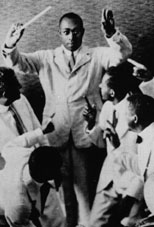
James Reese Europe
If you watch the Ken Burns "Jazz", there is an entire segment on the James Reese Europe Orchestra, and how these African- American musicians were considered crack readers. "They could read a moving snake! If a fly landed on the page, he got PLAYED!" But they would memorize everything and play without sheet music. Unfortunately, the white audiences just assumed that because they were black that they had no training, and just played by ear. I think some of those attitudes remain, regardless of the color of the musicians.

The top 6 things you can do to improve your sight reading are as follows:

1. Try to sight read brand new music everyday. Don't worry about what it is, or whether you like it, or what it sounds like. You are now a sight reading robot. You will read anything that is put in front of you. Go to the music library, dig out sheet music from your attic, borrow some books from your friends, whatever. The only criteria is that you've never seen it before.

"He'll read anything that's on the teleprompter"
2. Don't look at your hands; look at the music!( I realize this doesn't apply to every instrument.) How can you follow the music if you keep looking down at your hands! Learn to play by feel as much as you can. And keep your eyes on the music Think of the music page as the teleprompter, and you are looking at it like Ron Burgundy from Anchorman. ("He'll read anything that's written on there!")

3. Look over the music just before you start and find the trouble spots. Check for key changes, lots of 16th notes, weird rhythms, etc... just so you have a fighting chance before you put the pedal to the metal.

4. Look as far ahead as you can while you play. This is tricky, but it will help you to plan ahead. It's a different level of alertness. It's kind of like driving a car; you always have to keep your eyes far ahead, not just focused on the road in front of you. That way, you can react before it's too late. Same with sight reading music. The best sight readers read one or two systems ahead, let alone a few bars ahead. Try it next time you read and see if it helps.

5. Sight read and play so slowly or out of time that you don't play any wrong notes. This will help you with your accuracy, and will give you an idea of just how slowly you need to play to get everything perfect. It will help you develop your reflexes, and hopefully it will help you to play faster with accuracy in the long run.

6. Sight read and set the metronome; keep the tempo and don't worry about wrong notes. This is especially important for professional playing, because there is no time in the studio or in some accompanying situations to perfect every nuance. You need to play it up to speed. Especially with pianists, you might have to leave some notes out in order to keep the time. Basically, this is known as "faking it." But it's a good skill to have.

Good luck, and above all, be patient. Just 10 minutes a day can help. Maybe spend 10 fewer minutes on Facebook and sit down and sight read a new piece. You might surprise yourself if you keep at it.

Marching Baritone Part 2

The internet is really something else. I never really have a sense of your audience the way I do in a concert performance And then I'll be shocked to find out who is reading my blog. That's why I really try to speak honestly, but also thoughtfully, because I don't want to offend, especially folks that I respect. I like to debate, as long as there is no name calling and the conversation is respectful and relevant. And it's interesting to see which posts generate the most comments. My last blog regarding my new purchase of a marching baritone generated some cool responses, and I wanted to make sure you see them.


The first was from someone named Brandon:


Rich Matteson
So as a college student learning jazz on trombone after eight years of euphonium playing (including a year of attempted music majorness), I can say I kind of agree. I have to work much longer than any of the other students in the improvisation classes to get down simple licks (arpeggios, some 2-5-1 patterns, rotations), to the point where I'm going to be catching up on stuff I've covered in the past two semesters this summer. The few times I've decided to play my euph this year, it's been relative easy to take the patterns I've been learning on trombone and apply them almost immediately (it might help that I'll randomly finger them while bored class and such, because well thinking of things in valve combinations is still more natural to me). I also showed up to a few jam sessions last year with a Yamaha marching baritone and everyone thought it was a flugelhorn. But most of the people there were really psyched to see it, just because it was different (same when I brought the actual euphonium along).

But I think the main reason everyone learns trombone instead of one of the valved low brass instruments is that as few gigs as there are for trombonists at least trombone has somewhat of a pop culture name. As far as I know there were three jazz euphonists (one played on Ready for Freddie by Freddie Hubbard, one is Rich Matteson, and the other is Rich Matteson's succesor at UNF). And those guys only played in combos (well Rich lead a big band, but not many people lead big bands to begin with). That's the main reason I'm learning everything on trombone; I've learned it to play in big band and it seems like a waste to learn improvisation if I can't apply it in that setting (since right now that is the main place where I play). Big bands seem to be where most famous jazz trombonists play (or at least got started/made their name). Also, euphonium/baritone horn just doesn't fit in big band tonewise (especially euphonium). I've tried both, and it just sounds out of place. Maybe things would be different if I wasn't the only one not playing trombone, but the trombone section has a pretty well defined sonority that doesn't transfer to the other two (just different amounts of light/dark in the tone depending on range. Instead of sounding like a lead trombone, you get more of a french horn sound in the upper register). I mean, it might work in a manner similar to Stan Kenton's mellophonium band or with lead bone/bass bone and then two euphs/baritones playing third/fourth trombone, but it'd require a lot of experimentation and finding people who want to play baritone/euphonium.

But you're in a lot better place than I am to be experimenting with the baritone horn in a jazz setting (as you have steady gigs, and a job to boot). I definitely want to go back at some point and really transfer all the stuff I'm learning on trombone to euphonium and play them both at gigs. There are some songs (like Ceora and a few bebop songs) that I see the heads as being more trouble than their worth to try to play on trombone, but would be great to play on euph. Also, a real euph/four valved baritone horn (if you get one) has pretty much the same range as a double bass (using pedal tones), so it can fill a variety of roles.

I definitely want to see what you end up doing with the marching horn; please continue to post about it here (and maybe record yourself playing it at a gig please?). Also, yes it's very heavy, it takes at least two to three months of marching band practice before holding it for a ten minute show isn't painful, and even then it's tiring. Also, if you get a non-standard issue mouthpiece, you can get something similar in size to a trumpet mouthpiece (not as small, but enough smaller). Although most of those will be listed as trombone mouthpieces, because it's not like anyone really plays the baritone seriously, right?


I was glad to hear that I'm not the only one who was thinking along these lines.


Steve Turre
The next comment was from someone named Stephan Turre, which must be the great trombonist, Steve  Turre:


There is a thing called a "valve trombone" which exists...


Steve, of course! I thought of that first! For some reason, I gravitated towards this marching baritone monstrosity. I might live to regret it. Maybe I'll trade it for a valve trombone...


The third and most interesting comment came from none other than Frank Lacy. Lacy is one of the most underrated musicians there is. He's a great brass player, and composer, conductor, and bandleader, but he's one of the great jazz singers. Why he isn't a super star is beyond me. Lacy is also a very smart guy; I think he has a degree in Chemistry. I've enjoyed debating him on topics in the past(we had long discussion about Israel and the Middle East and Lacy really knew the history). Here is his comment:


As a brass player that plays all the brass instruments(french horn,trumpet,euphonium,baritone horn,trombone, and tuba) i feel compelled to address this, as a means of educating musicians about brass instruments. 
1) I love trombone jokes.......hard as it is to keep work as a trombonist, the jokes keeps me from crying... 


2) You totally failed to mention the mechanics of the rotary valve(i.e. the french horn) that can play eight and sixteenth notes passages cleaner than piston valves,hence,the reason the French horn is used in woodwind ensembles. 


3)What's with the slide? On the slide, it's POSSIBLE, because the slide is calibrated in POSITIONS, not fingerings as in valve and rotary pistons,keys(like on saxophones and pianos)or instruments of indefinite pitch(percussion instruments)to obtain the PERFECT intonation of a note, like a string instrument. Therefore, the trombone is called the stringed instrument of the brass family. 


Frank Lacy
4)The trombone is the ONLY musical instrument that comes closest to mimicking the HUMAN VOICE (check out Tricky Sam Nanton of the Ellington band).


 5) Because of it's cumbersome quality to play fast passages, it's easier to make the instrument SWING on the eighth note, and as of recent times(mid-nineties to present), I'm finding it increasingly hard to hear jazz musicians swinging on the eighth note due to more and more classical-tinged melodies in jazz compositions that one cannot recall 30 seconds after the tune is played. 


6)Since i've played with great composer/arrangers like Henry Threadgill, Slide Hampton,Jimmy Heath, Clifford Jordan, Muhal Richard Abrams, Mike Nock and Michael Formanek and others, not too many jazz composers have excercised the testicular fortitude and ejacalative viscosity to even TRY to study the workings of the instrument enough to WRITE for it CORRECTLY.As of RECENT times, I've had to rewrite most of the trombone parts I've had to play on !


I suppose you are right, Frank, regarding the possibility to be perfectly in tune on a trombone. But like any string instrument, it takes work to be able to hear it. So yes, advanced players can do it. Students can have a hard time. And I hear what you are saying about the classical tinged melodies which are forgettable. I'm not totally against that, but I do think that the whole, "let's play everything straight eighths, not swing, and have every melody be a technical exercise" is potentially dangerous. And Sam Nanton was an integral part of the Ellington sound, for sure.


Frank Lacy, also a great jazz singer....
I'm glad to get feedback on this. I've only had this baritone for 2 days. I tried playing it this morning before my history class, and I'm wondering how long the honeymoon will last. I'll let you know. 


Finally, this was posted on my facebook page from another great trombonist named Andre Hayward:


No hate at all George. I love the valves myself. There's nothing like the sound of a euphonium, baritone horn, or bass trumpet. I can't wait to hear you play it.


 I think you are going to have to wait, because I'm not ready! But give me a few weeks at least.....

Wednesday, May 9, 2012

Marching Baritone Part 1

Robin Eubanks, one of the great jazz trombone players
I've played with a number of really tremendously fine trombone players in my career: Robin Eubanks, Frank Lacy, Luis Bonilla, Christophe Schwietzer, Andy Hunter, Conrad Herwig, and many others. I have great respect for trombone players, despite all the great jokes at their expense.(What's the difference between a squirrel laying dead on the highway and a trombone player laying dead on the highway? The squirrel was on his way to a gig!)My college roommate was and currently is a really great trombonist( he lives in Boston and is playing full time.) So please don't send me hate mail for what I'm about to say.

SO.....Uhhh, what's with the slide? Is it really better than valves? Isn't much of a trombonists time spent trying to simulate with the slide what valves can do quite easily? Isn't it like using a horse and buggy when we have high speed transit? Now, some people will say that there are smears and things which are impossible on valve instruments. You can't get that with a half valve technique? Well, maybe they are right about that, but like I said, trombonists who are trying to play bebop lines would probably do a lot better with valves. (I'm really not trying to hate on trombonists! Please! Some of my best friends are trombonists......)

Bass Trumpet
My thought was that if a valve trombone magically appeared before me, my trumpet abilities would allow me to instantly double on the trombone. (I realize that the mouthpiece and air flow are quite different. We'll get to that.) However, my internet research led me to some other possibilities. I saw something called the marching trombone, which has VALVES, and looks like a big trumpet. I saw the bass trumpet, which is rarely used (except in Stravinsky's "The Rite Of Spring"), has an extremely strident tone, and also tends to be very expensive. I also noticed  things called marching baritones and marching euphoniums, and also flugabones. All of these things look like oversize trumpets. They were all kind of expensive, too.

Marching Baritone
 I remembered how much my sister Dana enjoyed played the baritone horn in high school. I figured that baritone is somewhere between a trombone and a euphonium in terms of timbre(trombone being bright and euphonium being much more mellow due to it's conical shape.)And I saw a really great deal on a brand new Hoss marching baritone(with case!) on EBAY, so I threw sanity to the wind and put in my credit card. Well, my marching baritone arrived TODAY! I was cautiously optimistic, especially considering that I already own many other instruments and barely have the time to practice them. However, I wanted to get a taste for low brass. I had only picked up a trombone maybe a handful of times as a joke, or when I was a Music Education major in college.

My new Marching Baritone
In some ways, I proved my point; playing a marching baritone is in some ways like playing a trumpet an octave lower. However, the amount of air is quite different, and will take some getting used to. Also, it is twice as heavy as a trumpet, and my left shoulder got tired very quickly. Furthermore, I think it will require some embouchure adjustment, since the negotiation of intervals with the lips is quite different on this double sized mouthpiece. Still, it was fun to be able to pick up a new instrument and be able to play something without having to learn a completely new fingering system.

I shall keep my readers informed on how this little experiment goes. I might include some youtube videos at some point, but for now, I have included photos, and you'll just have to imagine how it sounds.(Not great. But not terrible.) I showed the new instrument to some of my colleagues at PSU, and I'm pretty sure they think I need professional psychiatric help.

Yes, the amount of air needed for a marching baritone is much greater than what is needed for the trumpet; I felt dizzy after playing for only ten minutes. I actually fell asleep. While I slept, I had a strange dream; I dreamt that I left my marching baritone in the backseat of my car, and parked it on the street. When I returned to my car, I found that my car had been broken into ;now, there were two marching baritones in the backseat.......

Dan Cray:Meridies


Dan Cray and his new CD

Every time I turn around, there is a another great jazz pianist. ( I think we need to put a cap on the number of great pianists. Just kidding.....) Dan Cray is the latest to cross my path. His new CD, "Meridies", showcases his sparkling technique and intriguing musicianship. It's a disc that has some trio and some quartet. It's a very warm and balanced sounding album, and it's got some edge without being jarring. From the first track, "Smile", you can tell that Cray has a lot of tricks up his sleeve. The arrangement is in 7/4, and features a percolating bass line which implies something more sinister. Cray has command of the changes, but he has some nice rhythmic development. 
Bassist Clark Sommers holds it down nicely. Mark Ferber is one of my favorite drummers, and he always adds clean, refined power to any session. 

Mark Ferber, one of my favorite drummers
"Worst Enemy" is an aggressive original tune in 15/8, which also has a dark undulating bass line. Here Cray adds tenor saxophonist Noah Preminger, who does some astonishing work throughout. He's solidly modern; he's got the swing of a Greg Tardy, the altissimo of a Mark Turner, the speed of a Donny McCaslin, and enough reckless abandon to be a "musician of interest." 

"Amor Fati" is a contrasting move into introspective ballad territory, where Preminger reminds me a bit of Charles Lloyd. This is simply a duo; Cray is a wonderful, tasteful accompanist. "Serenity" is a Joe Henderson that most New York jazz musicians have played to death. Here, the tempo is brighter than normal, which adds to the challenge. Preminger kills it, verging on stealing the show. I feel like this could have used another take where the trio could have been a little more interactive. It almost seemed like they were holding back. Cray takes a nimble fingered ride. Cray has a lot of vocabulary, but he shines most when he takes a small idea and really plays with it. drummer Ferber nails the trading; I love his time feel, but when he solos, he really hits the drums!

Noah Preminger
"East" is another trio tune which relaxes and delights. These type of waltzes always remind me of Chick Corea's "Now He Sings, Now He Sobs". "Winter Rose" is a moody straight eighth piece which begins with a vamp harmonically implying C#-7b6 (or A/C#) to Cmaj7. Flat 6 chords always seem appropriate in these types of tunes. Once the melody enters, they veer off pretty quickly. Its colorful and gentle, although the New York vibe comes through in the vamp out. 

Mark Sommers
"At Least" is a soft one, with Ferber showing some nice mallet work. The tune begins in 5, divided in 2 and 3. The melody has a little shade of Mingus blues in it. There's great bass solo by Sommers, and the piece builds in a very feel-good way, until it dies back down again. "March Of The Archetypes" features Ferber beating the mess out of the toms. It's a real contemporary New York type of tune; lots of harmonies, fusion rhythms on the funky side, and burning solos, which are never deterred by any harmonic or metric challenge. You won't go wrong with "Meridies". Dan Cray is another new member of the great jazz piano club.