Showing posts with label CD Reviews. Show all posts

Tuesday, September 29, 2015

"Alphabet City:" Brian Charette's Triumphant New Album


Brian Charette
Hammond B-3 organ is kind of a thing unto itself. It's not just an instrument, it's a lifestyle. You could take that literally when you consider that, whether you play a "clonewheel" ( meaning a digital keyboard which is designed to emulate the B-3 sound) or an actual B-3, C-3, or what have you Hammond organ, you need at the very minimum a car, or maybe a van, a storage space, and perhaps 3 friends to help you carry the organ into the club
( hopefully not up the stairs!). Don't forget about the Leslie speaker! I have always considered myself a dabbler in the B-3 lifestyle( I've recorded and toured as an "organist" but I'm not anyone's first call...also didn't have three friends to help with the lifting....ha ha). It seems as though older generations delineate clearly who is a pianist and who is an organist( meaning you won't see McCoy Tyner playing organ, or Jimmy Smith playing piano....not that I'm aware of....at least not frequently.....). Among the younger generation, you have the dyed in the wool organists like Joey DeFrancesco, Cory Henry, Pat Bianchi, Jared Gold, and then you have the guys who went from piano to organ, like Larry Goldings, Gary Versace, Mike LeDonne (and I guess yours truly.....come on Downbeat give me a chance......).

Then you have Brian Charette. After reading Charette's bio, I see that he has a classical piano background. I am familiar with some of his writing in Keyboard magazine on the harmonic techniques of Olivier Messian.  Charette could be put in the latter category of pianists turned organists; however, after listening to his latest release on Positone, " Alphabet City," he has convinced me that organ is his true calling. He's so convincing on the instrument; the bass lines, the groove/hookup with drumming wiz Rudy Royston, the fluidity of his right hand, the cool drawbar settings he uses for "comping" for guitarist Will Bernard's solos- all of these things for me put him in the solid " organist's organist" category.

"Alphabet City" has something for every jazz fan: clever, brainy up tempo burners( "East Village"), funky jams( "They Left Fred Out"), medium tempo groovers( "West Village"), psychedelic fusion experiences( "Not A Purist"), soulful second line sermons( "Sharpie Moustache"), music for driving on the highway( "Disco Nap"), music for haunted houses("Hungarian Minor"), music for 70's TV shows("Avenue A"), and so much more. This is not " Back At The Chicken Shack" by any means, and yet Charette, even with the weird sounding smattering of synths and variety of moods, convinces me that the Hammond B-3 is his voice, and he's taking it out of the box and bringing it into the 21st century. Essentially, Brian Charette's "Alphabet City" is the type of  record I wish I could make!

Catch Brian Charette at the Jazz Standard on October 13.

http://www.briancharette.com/

Monday, August 10, 2015

"Blues For Tahir," Todd Marcus' Journey to Egypt Through Baltimore


Baltimore based Bass Clarinetist, composer, and bandleader Todd Marcus has mastered his own destiny with his latest release, Blues For Tahir( Hipnotic). On this new release, Marcus and his Jazz Orchestra hit all the crucial marks for ensemble playing, expressive improvisations, and bringing the compositions to life. Marcus' work here has a strong Middle Eastern influence which is evident in many of the main melodies; indeed, the theme of the album is an exploration of Marcus' Egyptian heritage, as well as a programmatic expression of the recent political and social upheaval in Egypt. However, this above all is a modern jazz record which leans towards composers like Jamie Baum, Michelle Rosewoman, and Kenny Wheeler, if not John Coltrane and Duke Ellington. Furthermore, the improvisations from Marcus and alto saxophonist Russell Kirk ( and to a lesser extent tenor saxophonist Greg Tardy) show a strong influence of Baltimore's own tenor saxophonist, Peabody jazz program director and musical original Gary Thomas. Add in Baltimoreons like bassist Jeff Reed, drummer Eric Kennedy and percussionist Jon Seligman, as well as my former Peabody classmate and now Peabody professor , trumpeter Alex Norris, and this music is as much about the state of jazz in Baltimore as it is about the state of Egypt.


Although this is described as a Jazz Orchestra, it's really more of a large chamber group, and the balance of ensemble playing and solo space throughout "Blues For Tahir" is superb. Marcus knows how to combine bass clarinet, flute, trumpet, alto, and trombone in a way that is impressive without trying too hard. The bass clarinet in ensembles like this often functions as doubling the bass line ( with the piano also on "Many Moons") or merely to add exotic color ( I'm sure you could ask  bass clarinetist Benny Maupin about that!) but Marcus insists that the bass clarinet can also be upfront. Marcus often solos in the mid to high register of the instrument, weaving complex lines which surely show the influence of Gary Thomas' linear concept. Marcus features himself sufficiently without denying his excellent bandmates some chances to blow. I wasn't familiar with alto saxophonist and flautist Brent Birckhead but he takes a marvelous turn on "Protest," in an aggressive post-Coltrane, post-Kenny Garrett type of blowing against a modern version of "stop-time."

"Alien" features solos from virtuoso trombonist Alan Ferber and pianist Xavier Davis, who throughout the album shows his considerable prowess as a accompanist. The rhythm section of Davis, bassist Jeff Reed ( who has a beautiful feature on "Tears On The Square"), drummer Eric Kennedy( who burns it up on "Washouli") and the addition of percussionist Jon Seligman( who is also an incredible drummer) is the foundation of this group and helps to solidify the music. ( One thing I noticed while listening to " Reflections" is that whatever type of drum is being played by Seligman has an overtone which "clashes" with the G7 suspended sonority prevalent throughout the section. It's not a bad thing; it adds to the exoticism. I'm not sure if it was intentional but it sounds cool.)I was a bit concerned at first about where "Summertime," George Gershwin's classic, was going to fit on this recording, but Marcus puts his own stamp on it, and most importantly, gives his lead trumpeter Alex Norris a chance to burn out.

Todd Marcus has really come into his own with "Blues For Tahir." It's a showcase for Marcus' playing, writing, and thoughtful artistry.

Monday, September 22, 2014

Herbie Hancock Quartet in Portland

It's always great to hear live music, and it's always a privilege to get to hear one of the greatest musicians to ever walk the planet give a concert in one's hometown. One of my true heroes, Herbie Hancock, brought an all-star quartet to Portland's Arlene Schnitzer Concert Hall last night. It was not sold out, but close to full, and as Mr. Hancock alluded, the "vibe" was great. I think oftentimes, jazz concerts in big halls fill up because of name recognition, regardless of whether anyone knows an artist's work. I think it would be hard to find someone at last night's venue who hadn't at least heard "Chameleon," or "Rockit," or at the very least "Watermelon Man."( Actually, some people walked out rather early; they may have been expecting something more in the "traditional jazz" vein.)

Hancock's ensemble featured the great Lionel Loueke on guitar and vocals, who almost stole the
Lionel Loueke
show with a solo feature where he used effects pedals to make it sound as though he could use his single voice to make the sound of a West African choir. James Genus, one of the great bass players in jazz and fusion( if you have seen Saturday Night Live, he's sitting in the band on stage left during the opening monologue) was holding it down on electric, but also took some beautiful solos. The drummer, Vinnie Colaiuta, is arguably one of the greatest drummers ever in history. (Hancock alluded to Colaiuta's regular gig with Sting by saying, " he has a day job!")That being said, when the quartet opened with "Actual Proof," one of Hancock's classic tune from the 70's album "Thrust," I found myself missing drummer Mike Clark's raw Oakland funk and jazz vibe rather than the slick fusion vibe of Colaiuta. Again, don't get me wrong, few can play with the combination of precision and heart the way Colaiuta does.( I actually recorded with Colaiuta on a Richard Bona album called "Tiki.") Later in the concert, Colaiuta did some ferocious displacements on a funky version of "Cantaloupe Island."

Vinnie Colaiuta
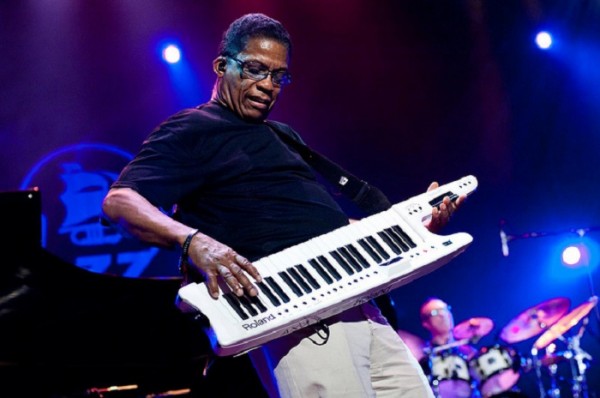
Hancock, who I believe is 72 years old, had more energy and enthusiasm on stage than most of my students! He still plays the piano with so much reckless abandon, and also switches easily between acoustic piano and electric keyboards. He jumped around the stage with his keytar like the lead guitarist with a hair band! It was definitely a fusion kind of event, although a solo piano intro to "Speak Like A Child" (which seemed to be in three keys at once) was definitely worth the price of admission( which surprisingly was only $35 dollars each for us!). In a time when we are losing a lot of the older masters, it's nice to know that Herbie Hancock is still out there playing with the spirit of a teenager.

Monday, March 24, 2014

Two New Ones: Amber Epp and Peter Zak

Pianist Peter Zak
I haven't had a chance to do CD reviews lately. Now that I'm on Spring Break, all 7 days of it( oy gevalt), I have some time to check out some new albums. One that I'm highly overdue to check out is pianist Peter Zak's latest for Steeplechase. "The Eternal Triangle" is a wonderful trio date which balances meaty originals with choice, not often played standards. The piano sound is nice and dark, and Billy Drummond's clear crisp cymbals are unmistakable. (I've recorded a number of Steeplechase dates with Drummond and his fiery swing always makes the music fun.) The always solid Peter Washington holds down the foundation and takes some excellent solos as well.

I was particularly intrigued with the slow blues called "Hittin' The Jug." I love all kinds of jazz, but it
is extremely grounding to hear an experienced group lay into a nice slow Bb blues. It's what we call "grown folks music." But there's also some satisfying, modern-leaning music; "George Washington" is a composition which begins with a fluid rubato intro followed by a hectic straight eight vamp tune that later gives way to swing, reminiscent of some of Mulgrew Miller's work( "Sublimity" from Miller's album "Work" came to mind). "The Hymnotist," another straight eight tune, has a lot of nice harmonies and bass lines which remind me of some of Geoffrey Keezer's writing. "I Believe In You," the standard from "How To Succeed in Business Without Really Trying," is a pleasant medium bounce. Zak's has a lot of maturity and class in his playing; he's a true New York musician, as are Washington and Drummond. This is a well rounded album and hopefully this will put Peter Zak out in the public eye a little more.

Amber Epp
My thrill as a jazz educator is seeing my students grow into great musicians. During my two year run as a professor at the University of Manitoba in Winnipeg, Canada, there were a number of students who stood out as destined for success. In particular, vocalist Amber Epp( who now that I think of it, studied piano with me for a year) showed the drive of ten musicians all at once. Epp, who grew up in a Mennonite community in Steinbach, Manitoba, discovered jazz and Latin music and never looked back. Epp is well on her way to a professional career with her first all jazz album, entitled "Inside Outside." Epp has a voice which is clear, controlled, and in tune with phrasing that sparkles with rhythmic flavor and enough playful soul to make you say, "No, she couldn't be from that little town in Manitoba!"

Joni Mitchell's "All I Want" is a good way to kick off the festivities; although it's a subtle
reinterpretation, Epp gives it a nice samba flavor( I could see this one getting airplay). The selection of tunes is wide in variety; Epp loves the Latin tinge, so it's no surprise to hear a sultry rendition of
"Dos Gardenias"( Epp lived in Cuba for a short while; her Spanish is muy, muy bien, yo creo) or an impressive Portuguese version of "Chega De Saudade" with rocking samba guitar work from Larry Roy and energetic percussive bass playing from Steve Kirby( makes me miss playing with those dudes! We used to play every Wednesday Night in Winnipeg....). But there's so much more. "The Boy Next Door" features the not often heard "verse" of the tune, as well as great interpretation from Epp and swinging drumming from the great Quincy Davis. Epp can change moods on a dime: from the bluesy shuffle "Hey Now, " where she confidently struts her warm tone and popping rhythm, to the sensitive closer, Bernstein's "Some Other Time," where Epp rediscovers the bittersweet moments with a softer, muted sound. As one of her former teachers, I am bursting with pride about this recording; Amber Epp is going to thrill jazz lovers beyond Manitoba with this new CD.

 http://www.peterzakmusic.com/
http://amberepp.com/index2.php#/home/


Wednesday, February 19, 2014

"RUSH": Tom Guarna's New CD is a Winner

Guitarist Tom Guarna
If you are looking for some new New York type of jazz, high energy with compelling yet soulful compositions and an all star cast, then look no further. Tom Guarna's latest album, "Rush," is guaranteed to satisfy your inner jazz critic. Guarna is one of a new breed of musicians who has studied the traditions, has skills to burn, but is not afraid to push the envelope and go outside the box. 

I like to call this music New York Jazz, although some might erroneously call it Fusion. It is not fusion in the sense of reminding us of the Jazz Rock of the late 60's and 1970's, although Guarna and company are no doubt familiar with the subgenre. There is a lot of swing, and with the exception of electric guitar and Fender Rhodes on some of the tracks, it's an otherwise acoustic album. If one means fusion in the sense of this is music with many influences fusing to create a
singular sound, then I'll accept that. But this is no Return To Forever ripoff; Guarna has his own vision and "Rush" unmistakeably brings it to life.

From the title and opening track, the SOUND of this recording will grab your attention. It's a big, clear sound, all of the instruments sound warm, and it's full without sounding overly compressed. The song "Rush" is a kind of spinning wheel of energy based on a low register 3/4 guitar riff; from there, Guarna and saxophone monster Joel Fromm join together to play weaving lines while the rhythm section of pianist Danny Grissett, bassist Orlando le Fleming, and drumming master Johnathan Blake drive the engine. Guarna's composition's are heavy, but they don't take themselves too seriously, and there is plenty of space for blowing. On "Shambleau, " a kind of D minor swing which really opens up, Joel Fromm begins his solo with a high degree of harmelodic nastiness which I don't often hear from him. 

Danny Grissett has been in high demand as an accompanist for years; I especially enjoy his floating textures on "Dreamland." I've recorded with Johnathan Blake and used to play with him quite a bit; now, it seems as though every time I turn around and say, "That drummer on the recording is KILLING! Who is it?" -well, 9 times out of 10, it's Johnathan Blake; he's nailing everything Guarna has given him. A tune like "Movement and Repose" is clearly an
Johnathan Blake
obstacle  course of a challenge, and Blake, as well as bassist le Fleming, handle it with ease.


I'm hoping that "Rush" will be the album that will push Tom Guarna into the conversation which includes Kurt Rosenwinkle, Johnathan Kreisberg, and Gilad Hekselman; Guarna is easily in that category, in fact, this recording proves he is in his own category.

"Rush"(Brooklyn Jazz Underground Records) will be available for download on Itunes on February 25th. Also, check out the BJUR site, as well as Tom Guarna's site. Also, here are Tom Guarna's tour dates:

Feb 23
Tom Guarna Quintet
CD Release Show
55 Bar
NY NY
Jon Cowherd - fender rhodes
Orlando le Fleming - bass
Chris Cheek - saxophone
E.J. Strickland - drum
9pm to 12am

March 1
Manuel Valera's New Cuban Express
Cullen Theater, Wortham Theater Center
Houston TX
8pm

April 16th
Tom Guarna Quartet
The Blue Whale
Los Angeles CA
CD Release Show 8pm to 12am
Mark Ferber - drums
Dave Robaire - bass
Miro Sprague - piano

April 17th
Tom Guarna Quartet
CD Release Show
Dizzy's
8pm to 11:30pm
San Diego CA
Joshua White - piano
Mark Ferber - drums
Bass - TBA

April 18th
Tom Guarna Trio
Vibrato
8pm to 12am
Los Angeles CA

April 21
Tom Guarna Masterclass
Portland State University
Portland OR

April 22
George Colligan Group
Jimmy Mak's
Portland OR
Damian Erskine - bass
Reinhart Melz - drums
George Colligan - piano/keys
8pm to 12am

April 23
George Colligan Organ Trio
Jo Bar
Portland Or
8pm to 12am


Saturday, February 8, 2014

Soweto Kinch


Soweto Kinch
Sometimes I'm just late to the party; I recently discovered a wonderful musician from England named Soweto Kinch, who is equal parts alto saxophonist and rapper. Kinch's vision is very fresh to me; when I hear music like this, it makes me want to stop talking about learning standards and tradition and so forth and start talking about going forward. Kinch has combined a rock solid gift for jazz alto saxophone with a very distinct and engaging lyrical flow that is truly a revelation. Soweto Kinch has been out there for about a decade, but I guess I've been preoccupied with Facebook or something.

I used to be very sensitive about the notion that Jazz in Europe is becoming more innovative while
many American musicians cling too strongly to the past. Well, musicians like Soweto Kinch sort make me want to eat my contrary words; Kinch blends hip hop and jazz so well, it's almost a perfect fusion.  Kinch's alto sound reminds me of Kenny Garrett, Steve Wilson and Vincent Herring; the tone has the crying hard edge I love, and he has a very fluid sense of melody and rhythm. On 2010's "The New Emancipation," the tune called "A People With No Past" jumps out with a swinging soaring sequential melody nicely countered by guitarist Femi Temowo. Kinch the jazz musician is without a doubt an expert navigator of chord changes. " Trying to Be A Star" shows off Kinch's lyrical expertise; at times, it's almost more like spoken word, but then also has a Busta Rhymes sort of behind the beat feel. (I think it's refreshing that Kinch makes no effort to hide his British accent.)

The sonic palette of 2009's "War In a Rack" is euphoric, symphonic. "Can't Hold Me Down" alternates many voices with Kinch spitting rhymes with overwhelming intensity. Contrast this with another EP from 2008, " London Sessions, " a live date which is somewhat more spacious: a blend of acoustic jazz/groove with lyrics, Kinch's flow is no less impressive. The opening track, "Ridez" is a bottomless pit of creativity. "Adrian's Ballad," which begins rather conventionally, leads into a very dramatic lyric. The final track, "Freestyle," is a funny interaction with the audience trying to find a word with which to flow spontaneously. It's mind boggling how comfortable Kinch is with rhyming off the top of his head.(Perhaps his studies of Modern History at Oxford helped with that.)

Soweto Kinch's latest is "The Legend Of Mike Smith," a concept album about a young rapper trying
to get into the business, dealing with phony music executives. (I get the feeling that this would be what you might get if Miguel Zenon and Wu Tang Clan somehow made a record together.) The double album follows a narrative but never leaves the music behind. " The Dream" is Shakespeare with a hip hop groove; it's sophisticated English poetry with rather wild orchestrations accompanying. The whole album feels like a Hip/hop Opera. It's a magnum opus from an artist who I hope has many years of creative output ahead of him.

http://www.soweto-kinch.com/


Monday, January 13, 2014

Lost in Polish Translation


Poland, I love you! I do!
I am always happy to get positive press. I was just made aware of a review I received on a Polish blog from writer Robert Ratajczak. It's a nice review; of course I didn't know until I ran it through the "Translate Polish To English" program. Again, I want to emphasize that I appreciate the good review, and I thank Ratajczak for his compliments. However, I couldn't resist printing the translation, because it is unintentionally funny. I want to reiterate that I am in no way making fun of the Polish language, or the Polish people. I am making fun of the translation program's result. That is of course in addition to promoting myself shamelessly. Which is really what the internet is all about.


The original can be found here. Here is the translation:

Versatility George Colligana often delights and surprises jazz lovers . The 45 -year-old New York-based multi-instrumentalist ( piano , drums , trumpet ) and composer born in New Jersey is an exceptional leader of their formation ( of which so far has published more than 20 CDs ) as well as very desirable by the greatest contemporary jazz sideman . Over the years it has had the opportunity to hear , among others, Lee Konitz the constellations , Richard Bona, Cassandra Wilson , Christian McBride , Buster Williams , Al Foster, Benny Golson or . As a pianist, he is led by his mentors : McCoy Turner , Thelonious Monk , Chick Corea and Herbie Hancock , adding to their great inspiration a great deal of his own eclecticism also supported by careful education in the field of classical music.The latest project Colligana is based on the idea of ​​the piano trio and the 10 new songs that fill his new 24 artist album '' The Endless Mysteries '', recorded together with Section dreams : the bass Larry Grenadier and the drummer is none other than the legendary Jack DeJohnette himself , with whom George Colligan has toured in the past few years.'' Waiting For Solitude '' is an excellent opening this brilliant album . What an exceptional mastery of jazz music and a kind of intuition ! Hard, full of depth piano chords , walking bass and oscillating quite invaluable skill DeJohnette , make it really hard to imagine a better persuasion on the part of the musicians on this album spend at least a few hours during repeated her hearing.More dynamic song is'' Song For The Tarahumera ''. Fast-paced , galloping bass Grenadier ( excellent solo in the middle of the topic ! ) , Jack DeJohnette synkopujący full of energy and lots of piano.Respite brings a quiet, impressionistic about '' Her Majesty '' maintained at an average rate . Colligan playing complex melodic structure while maintaining a kind of classical discipline and a wonderful piano cold. In the background '' crazy '' Jack DeJohnette , of course , and Larry Grenadier regales us in the middle of another improvised stunt .The central part of the disc is somehow separate chapter '' The Endless Mysteries ''. While the theme '' Liam 's Lament '' George Colligan appears to us as a great virtuoso harmonica -key melodica , perfectly controlling the breath and the space between the notes of the natural reverb sound of the instrument .Jack DeJohnette mastery dominates the '' It's A Hard Work '', juicy okraszonego of percussion and a great bass line . Colligan is here in the shadow sections, allowing the parties to dominate the piano his companions .Two further topics: '' Thoughts Of Ana '' and'' Outrage '' were composed by the pianist in response to the senseless shooting at a school in Newtown on Dec. 14, 2012 year. It is then the result of insanity 20 -year-old killer killed 28 children and teachers , including 6 -year-old Ana Greene - Marquez- daughter Colligana friend , saxophonist Jimmy Green. It is dedicated to the poignant theme '' Thoughts Of Ana ''.The second theme dedicated to this tragedy is full of expression and anger '' Outrage '' ('' Scandal ''), in which amidst the unique , dynamic party can clearly see the anger and resentment , which emanate instrumental parts . It's really very moving fragments album ...Beautiful ballad '' The Endless Mysteries '' derives from a deep listener somehow transfer the previous few minutes , opening the third chapter '' '' plates ; far more sober and calm emphasizing instrumental parts in place of the dynamics that accompanied us in the first part of the plate and the deep emotions that zdominowy the middle.An impressionistic '' When The Moon Is In The Sky '' and nearly 9 -minute , almost monumental about '' If The Mountain Was Smooth , You Could Climb It'' in style crown the work .George Colligan , Larry Grenadier and Jack DeJohnette is the ideal , in which each instrument can flawlessly , intuitively zakcentować every phrase and pause , either in the form of dialoguing parties and solo improvisation.In addition to '' Out Here '' (2013) Christian McBride Trio , is definitely one of the most interesting American positions recorded in the convention record piano trio in 2013.Jazz world championship - unusual and unique trio , excellent album !

Wednesday, December 25, 2013

A Christmas Miracle: My Review in the New York Times

I'm still in shock; I recently found out that my CD, "The Endless Mysteries"(Origin Records) was reviewed by Nate Chinen in the New York Times. Furthermore, it turns out it's a really positive review. It seems like most of the reviews have been positive far, but this is a little bit different. The review in the Times is potentially important for a number of reasons. First of all, it's very hard to get the attention of the Times, and with all of the jazz musicians in New York, there is certainly no shortage of material that deserves to be written about. Secondly, I have noticed that certain artists seem to get a little bump of legitimacy after a Times article.( Now, if I were to get a feature article by either Chinen or Ben Ratliff, I would be planning a world tour.)Thirdly, it's THE NEW YORK FREAKING TIMES. (Even my accountant saw the review!)

Whether or not this review is a game changer for my career is unknown; as I said, a weighty piece in the paper of record has helped many artists to get more recognition. I'm hoping that this, as well as a forthcoming feature in Downbeat, will give me a boost with promoters and bookers. However, it might just mean bragging rights and not much more. The jazz business is still tough. I am still very pleased, and hopefully, all of this will at least be promotion for my New York CD release at the Jazz Standard on April 30; at this writing, the band on the recording (DeJohnette and Grenadier) has agreed to make the date.

In case you missed it, here is the review:

GEORGE COLLIGAN“The Endless Mysteries”(Origin)
One of the finer piano trio albums of 2013 —  released too late in the year, or on too small a label, to make a dent in the critics’ polls —  is George Colligan’s “The Endless Mysteries.” It’s a program of original compositions, most of them sensible and sturdy. And because it was recorded in a few hours with no rehearsal, it’s the product of rough-and-ready postbop expertise, rather than the lived experience of a steady band.
At least, not any band led by Mr. Colligan. A pianist of deep harmonic and rhythmic assurance, and sideman credits all over the map, he works here with the bassist Larry Grenadier and the drummer Jack DeJohnette. Each is a long-running member of another piano trio: Mr. Grenadier has been in both editions of the Brad Mehldau Trio, going back nearly 20 years; Mr. DeJohnette has spent the last 30 with Keith Jarrett.
Whatever the sum of all that experience is, Mr. Colligan made it work for him. Some of his pieces on “The Endless Mysteries” seem designed for these specific partners, especially Mr. DeJohnette, in whose band he has played. “Song for the Tarahumera,” a scrappy modal tune, becomes a roiling drum incantation. “Liam’s Lament,” a beautifully restrained ballad, features empathic rubato work by Mr. Grenadier. (It also features a theme played on melodica, an instrument that Mr. DeJohnette has favored on his own albums; I had to check to be sure that it was Mr. Colligan doing the playing.)
Mr. Colligan, who turns 44 next week, favors an earthy, assertive style, putting him in a lineage that includes McCoy Tyner, John Hicks and Mulgrew Miller. But he has other affinities, as he shows in a pair of spontaneous inventions provoked by the school shooting in Newtown, Conn., which claimed the daughter of a friend and sometime band mate. “Thoughts of Ana” is a softly chiming solo reflection, with a touch that brings Mr. Jarrett to mind; it leads into “Outrage,” which borrows a page from the Cecil Taylor playbook.
None of these moves feel calculated or rigid, because Mr. Colligan and his partners work so fluently. And while some titles sound like the sort of exhortations that Mr. Colligan might use with his students at Portland State University in Oregan —  see “It’s Hard Work!” and “If the Mountain Was Smooth, You Couldn’t Climb It” —  he doesn’t seem to be straining in the slightest. He’s past that point by now. NATE CHINEN


Tuesday, December 10, 2013

Jamie Baum's Latest: "In This Life"

Jamie Baum
If you want to make it as a jazz musician in New York, I believe you have to be somewhat versatile; you should know standards and be able to swing and play changes, but you also have to be able to read anything and play odd meters. You should have a sense of how to play "free" music, but you should also be open to playing music that you have absolutely no preconceived notions about! When I worked with flautist Jamie Baum's band, I could tell right away that I was going to be challenged musically beyond the known realms. I had years of great experiences playing with her groups of various sizes. After spending time with Baum's aggressively contemporary music, I knew I could play anything.

Jamie Baum is not only a strong relevant voice as a jazz composer, she is an excellent flautist; her tone, on flute or alto flute, is dark and rich. Her melodic concept is influenced by bebop and post bop but has a certain chromatic angularity which implies harmonic exploration. She's been on the scene for many years; I was recalling that the first time I worked with her was at Twins Lounge in Washington, D.C. in the early 90's. Originally from Connecticut, she's been in the Big Apple for almost two decades. Baum is a standout soloist and a confident bandleader, however, the group with which she seems to work most often is a septet with the instrumentation of flute, trumpet, french horn, alto saxophone, piano, bass, and drums. She features herself but isn't afraid to share the improvisational space.

Her latest recording, "In This Life,"(Sunnyside), is the third of a Septet Trilogy( the previous two
being "Moving Forward, Standing Still," and "Solace"). The CD is as expected mostly original compositions( with the exceptions of "The Game" and "Sweet Pain" which were written by Nusrat Fateh Ali Khan, an incredibly dynamic Pakistani singer). As Baum's music develops, her comfort with complexity seems to enhance her ability to be expressive. Snarky bass lines("Monkeys of Gorkana"), wildly inventive melody and harmony lines("The Game"), odd meters("Inner Voices", "While We Are Here"), longer unpredictable forms("Ants And Other Faithful Beings") and plentiful energetic improvisations all thrive here, but there are also distinctive, tuneful melodies and quiet moments. "In Another Life" is a beautiful ballad, which is gentle and thematic without being predictable. "Sweet Pain", with low flute and trumpet and exotic tablas of Dan Weiss(who happens to be one of the most unique drummers around) has a very tranquil, mysterious mood. "While We Are Here" is a actually rather positive tribute to Baum's cousin who died in 2010.

Baum's music in the past made much use of the 20th Century European classical music influence. "In This Life" has a more Eastern Tinge than previous recordings. However, this music is brought to life by Baum and her musicians, who are above all New York jazz musicians. Baum's husband, Jeff Hirshfield, has played with virtually everyone in Jazz, and is the skillful glue that holds all of the musical mishagos together. Alto saxophonist and bass clarinetist Douglas Yeats has been associated with Baum for many moons, and is one of the most exciting improvisers of whom you probably and sadly have never heard(check out his solo on "Richie's Lament"). I always love trumpeter Talyor Haskins conception; he's rock solid as a "lead" player and here he is featured as a soloist on "Monkeys Of Gorkana." However, another trumpeter named Amir Elsaffar is on the bulk of the CD; on the opening track, "Nusrat" he plays some wicked microtonal lines, channeling the South Asian sound (much like my former bandmate Rudresh Mahanthappa leans towards on the alto sax).  Guitarist Brad Shepik's ferocious solo on "Nusrat" makes me wonder why he isn't a household name.

Many of my students listen to the classic recordings- bebop, cool jazz, hard bop, Trane, what have you. But what about today's jazz? If New York is still the jazz mecca, then what are they playing in New York now? "Jamie Baum's "In This Life" is what New York jazz in the new millennium is all about.

http://jamiebaum.com/
http://www.sunnysiderecords.com/


Wednesday, September 4, 2013

Some Cool Discs

Gerry Gibbs
I haven't done any CD reviews for a good stretch, but I'm determined to tell you about three recent CDs which have come across my desk. Who am I kidding? CDs? These were all in a digital format. Although CDs are in danger of extinction, reports of their complete demise have been greatly exaggerated. There are places in the world where people love to buy actual CDs; some folks still love buying vinyl, believe it or not. Still, I find myself dealing more and more with an all digital experience with many recent albums. Anyway, what's really important is that the music survives, and that we don't take it for granted. A CD, or even a record, has a certain tangibility that digital doesn't; you are more aware of that particular disc, whereas when you have your music in a bunch of folders, it just seems like a bunch of.....well.....folders. Who knows? Perhaps twenty years from now, we will be thinking back on Mp3s with much nostalgia. And we will be kvetching about it on whatever will be the future equivalent of Facebook.

The first Steeplechase album I ever played on was a date lead by tenor saxophonist Jed Levy (called "Sleight Of Hand" on the Steeplechase label). The date featured the wise bassist Ron McClure and the precocious drummer Gerry Gibbs. Mr. Gibbs has been on the New York scene for decades; although he's always busy with various projects, he's fairly underrated in the lager scheme of the jazz world. Hopefully, his latest disc, "Thrasher Dream Trio" will change this notion. The "dream" refers to the all star line up of pianist Kenny Barron and bassist Ron Carter; clearly, it would difficult to dream of a better line-up than this! ( It was also recorded at the "dream " studio of Systems II in Brooklyn, which has always been one of my favorite places to record.While oftentimes all star projects can seem to be more about the name combination and sound a bit uninspired, "Thrasher Dream Trio" sounds like a BAND! It's a great sounding focused trio sound, and the playing is virtually flawless. There are a lot of snappy presentations of familiar jazz or pop material, but none of it sounds hackneyed; Monk's "Epistrophy" is finger poppin' good, " The Shadow Of Your Smile" is subtly arranged in a fresh key ( D major, or starting in B minor), and "Impressions" is more relaxed than usual, with some tasty hits. Some tunes like Freddie Hubbard's "Mr. Clean" and Stevie Wonder's "Don't You Worry 'Bout A Thing" will surprise you with a burning swing feel. I was quite impressed with the fastest version of Herbie Hancock's " The Eye of The Hurricane". I was also touched by Gibbs' original "The Woman On The T.V. Screen", a hauntingly beautiful ballad which Gibbs wrote for his wife Kyeshie. I'm not exactly sure if this album is available yet but here is some more info on the project. Anyway, keep an eye and and ear out for this special project.


 Another project you might enjoy is by a pianist and vocalist who I met here in Portland; Kerry 
Kerry McCoy
McCoy, who currently resides in Los Angeles, has released a beautiful disc called "Chasing After Shadows", which is a collection of his original songs backed by his own piano playing in a jazz trio setting. It's refreshing to listen to honest music; McCoy's lyrics are heartfelt and unpretentious, and his accompaniment is a great bed on which his melodies can rest. Songs like "A Million Roads" and "Until Tomorrow" and of course the title track are songs not about trite subjects, but about  experience and wisdom. There's also some humor; "You Want Fries With That?" is a silly commentary on how we end up in our stations in life. I won't spoil the surprise, but it's cool because it intersperses the lyrics with some light piano soloing. McCoy also presents "Angel's Sleeping", a lush ballad which I'm guessing is about his
young daughter ( who I think is about as old as my son, 3 and halfish). McCoy has a vocal style which is a clear mid tenor. He's no slouch as a pianist, which you will hear in his expert comping and his tasteful solos. I don't think Portland gave McCoy enough attention while he was here. But you can check out "Chasing After Shadows" on CD Baby.

Finally, I downloaded this third album a bit reluctantly; actually I'm mostly joking. It's just that when I listen to Geoffrey Keezer play piano, I love the music, but the pianist in me wants to at best quit piano, and at worst kill himself! I kid, but if you play piano and you've listened to Keezer on recording or especially live, you'll feel me. Indeed, hearing Keezer at
Geoffrey Keezer
Bradley's in the early 90's has been kicking my ass to practice ever since. His latest solo piano record is called "The Heart Of The Piano" on the Motema label. I used to listen to his solo disc entitled "Zero One" and this is reminiscent of that; the material is not exactly what you might expect from a "jazz pianist." The frist song is from the Canadian rock band Rush; if you were a fan of "Moving Pictures," I guarantee you have never heard "Limelight" played like this.( It might interest you to know that I saw Keezer at my gig in Los Angeles; he told me he's seen Rush live almost 30 times. I was quite jealous...) Keezer plays an almost Keith Jarrett-ish version of Peter Gabriel's "Come Talk To Me", which showcases his lyrical touch, but his still driving rhythm, even in the midst of a more impressionistic setting. I would expect Keezer to play a crushing version of Donald Brown's "New York," a composition which says much about the arguably Mecca of Jazz.
There's a shade of eastern mystery on Alanis Morrissette's "Still," which is a bit more impressionist; Keezer demonstrates more depth of tone control as the album goes on. I dig his treatment of Christian McBride's "Lullabye For A Ladybug"; it's got everything in it, from classical tinges to gospel implications to impeccable right hand lines, and the whole range of the piano is well used. This album is not only a great collection of performances, it's a piano lesson and a music lesson.

Speaking of Geoffrey Keezer, if you happen to pick up the August issue of Keyboard Magazine, there is an article by Keezer called "5 Things I've Learned About Solo Jazz Piano." It's the hippest article not only in the entire magazine, but one of the hippest short articles I've seen in Keyboard in a while. I'll have to nudge Jon Regen as to why it was not mentioned on the cover. If you have questions about solo piano, buy Keezer's CD and the August issue of Keyboard and you'll have lots of work to do.

Monday, July 29, 2013

McCoy Tyner-Soliloquy

Heroes give us inspiration to achieve our own goals. One of my heroes is pianist McCoy Tyner. I've been inspired by his piano playing for as long as I've been listening to jazz. I first heard Tyner on the John Coltrane album "My Favorite Things." It's interesting because I used to listen to the title track quite often; Tyner's piano solo on this track is much more meditative than what most listeners have come to expect from a McCoy Tyner piano solo. It wasn't until I heard "A Love Supreme" and Freddie Hubbard's "Ready For Freddie" did I start to really understand. After hearing things like "The Real McCoy" and "Supertrios" and "Expansions" and "Inception" and Coltrane's "Live At Birdland" and "Impressions" and Wayne Shorter's "Ju Ju" and so forth, I was really hooked.

When I was just starting to get serious about jazz piano, I was what you might call a McCoy Tyner "clone." A saxophonist named Phil Burlin wrote a song called "Colligan's Groove" which was essentially a catalyst for my McCoy Tyner imitation. As much as I loved what I believed to be Tyner's conception, I felt as though I need to move on to other influences. In essence, I had to STOP listening to McCoy Tyner. I know other musicians who had similar realizations; for example, another pianist had the same issue with Herbie Hancock. I believe it's important for musicians to have at least a handful of influences; that way, your source material is more varied, and you end up sounding more original than if you only check out one or two players.

All that being said, I suppose that the Tyner influence will always be a part of my playing. Furthermore, there is so much Tyner that I haven't checked out; perhaps surprisingly, there are times when Tyner takes different approaches than the muscular pounding we have come to expect from him. For example, I saw Tyner performing solo piano in the early 90's; he played standards, ballads, stride piano, and was actually rather laid back. That performance was a real lesson for me.

I was turned on to a wonderful solo piano recording of Tyner's called "Soliloquy." Marcia Hocker, a
Marcia Hocker
DJ on Portland's jazz radio station KMHD, told me several times about how much she adored this recording. Finally, she was kind enough to actually bring me a copy. I've been listening to it since then. It's given me a whole new reason to be obsessed with McCoy Tyner's music.

"Soliloquy" was released on Blue Note in 1992. It's an interesting recording for a number of reasons. It sounds as though it was recorded with the microphones somewhat far from the strings of the instrument, more like the way many classical piano recordings are made. There is a lot of room sound. The tone Tyner achieves is completely even, and it's somewhat darker overall from what you might be accustomed to. We are used to hearing Tyner with a rhythm section, so we know about Tyner's rhythm. However, even alone, his time is impeccable, but also, he has a really beautiful sense of rubato; tunes like "Tribute To Lady Day", "After The Rain", and "Twilight Mist" would rival the solo recordings of Bill Evans in terms of sensitivity.


Tyner has enough variety to sustain one's attention throughout; there's a tune called "Espanola" which begins with an almost classical touch, but then builds into a Spanish-tinged romp, but with a lot of dynamic contrast. There are some old favorites like "Effendi", 'Three Flowers" and Coltrane's "Crescent." It's super cool to hear how Tyner approaches tunes like "All The Things You Are," and "Bouncing With Bud,"lest you thing that Tyner is only capable of modal excursions; he has way more depth than he is given credit for.

"Soliloquy" is available here.

Friday, February 8, 2013

Wayne Shorter Part 2 Electric Boogaloo

 I think the Wayne Shorter controversy has run it's course. It has come to my attention that the young man who said terrible things about Mr. Shorter is actually a very troubled human being and probably needs someone to help him. I really hope he gets the help he needs. We don't need to bash him or shame him. That's already been done. I think this kid is hurting. Send some good thoughts his way. He might not be ready to get help, but I want peace in this world and one way to create peace is to love those who maybe don't love you.

In the meantime, I got this in the Facebook "mail":

Hey Mr. Colligan: With all this Wayne-ing noise going on, I'd like to ask you a question. To my ears, I still think "High Life" is one of the very best albums I've ever heard, at least in terms of effectively cross-breeding the idea and /or potential of a "studio recording" with the idea and/or potential of "jazz expression". Yet most of the critical comments I've seen have tended to be lukewarm at best. Care to comment? Thanks in advance.

Excellent question. My first reaction is that many critics have their heads up their you-know-what. Coltrane's "A Love Supreme" was panned. My second reaction is that I haven't listened to that recording in a long time, so this is a perfect time to pull it out and listen to it again.

I think one thing that's amazing about Shorter's career is that he is a great improviser, and played with such freedom with the Miles Davis Quintet. But he also has a flair for long form composition. "High Life" is a celebration of the latter. It's densely orchestrated, with REAL strings, REAL woodwinds, and some synthesizers and percussion. It's quite colorful, but it's more like symphonic music in that one, it's mostly written, and two, it's melodies and moods unfold slowly over time. It's not a head-solos-head affair at all; this is a Magnum Opus kind of session, which I imagine probably took a lot of time and energy to finish. 

I think we have a tendency to jump too quickly to conclusions about music. If we hear one recognizable element, we want to immediately throw it in the "style" box. " Oh, this is funk..." or whatever...."This is fusion." As I listen to "High Life" some more, I marvel at it's harmonic complexity, and the way that Shorter is able to solo melodically over these types of polychords, chords which make "Giant Steps" seem like a blues in comparison. One cool thing about Shorter's music throughout his career is that he uses common tones between chords, which functionally may have nothing to do with each other, and makes it seem like a natural progression, all the while creating a singable, simple melodic statement. In this way, "High Life" is just a long form, highly orchestrated version of his earlier work. 

I couldn't help but listen to this music and remember former New York Times jazz critic Peter Watrous' highly critical review of the album. Watrous used the following words to describe this music:

"...turns out to be a pastel failure and a waste of his enormous talent..."
".... it is as if Picasso had given up painting to design greeting cards...."
"...simply, it's an eager-to-please instrumental pop album..."
"....only a vestigial relationship to mainstream jazz and virtually no connection to Mr. Shorter's glory years...."
"Mr. Shorter's "High Life," with its reliance on the most obvious pop back beats and its sentimentalism, is quite likely a commercial mistake. The real money nowadays is in acoustic music with intellectual weight. Mr. [Joe]Henderson, Mr. Shorter's label mate, sold 74,000 copies of "Lush Life." Mr. Shorter's three albums, electric and ostensibly commercial, recorded for Columbia during the 1980's never sold more than 20,000 copies apiece. "


Much of the article refers to what Watrous calls "The Curse Of Miles Davis." My interpretation is that Watrous just never could get with "fusion" music, and seems to think that Davis, Shorter, and Herbie Hancock should have kept playing straight ahead acoustic music. My opinion is that Watrous, obviously biased, should not have even been allowed to review this album. This is not only because he is clearly biased against the music based on boxing it into a genre, but he's not even calling it fusion, he calls it "eager-to-please instrumental pop "! My question is: what the heck is Watrous hearing? Does he have any ears at all? Did he even listen carefully to the entire recording? If he doesn't have the chops to understand it, or if he doesn't have the time to listen to it, then he shouldn't be allowed to write in the newspaper of record about anything. My feeling is that this review is practically libel, and if Wayne Shorter cared(which I'm sure he didn't), he should have sued. 

This is why I believe music writers need to be held to a higher standard. First of all, words NEVER tell the proper story when it come to music. Here's an example; if  we are at a party where the folks know nothing about jazz, and Wayne Shorter and one of my PSU students are in attendance. Wayne Shorter says, "I'm a jazz musician," and  my PSU student says, "I'm a jazz musician, too," the folks at the party would think that Wayne Shorter and one of my students are equals. That's pretty insane if you think about it. 

In this way, Watrous flippantly reducing "High Life" to  "eager-to-please instrumental pop"
is in the same way false. In my view, he basically lumped Wayne Shorter in with Kenny G!

Folks, you decide:

Here's Shorter's brilliant reworking of "Children Of The Night":
 
And here is Kenny G's most popular tune:


  There is a big difference in what's happening with both of these songs: harmonically, improvisationally, thematically, and rhythmically. However, from what I read, Peter Watrous would put "High Life" in the exact same category. This is just wrong on a million levels.

In the way that our Facebook friend said terrible, disrespectful things about Wayne Shorter, shouldn't critics be held to an even higher standard? When you think about the fact that every moment of Shorter's musical life up to that point led up to the completion of "High Life." Every moment he spent practicing his horn, every lesson he took, every gig he played with Art Blakey, with Maynard Ferguson, with Miles Davis, with Weather Report, and so one. Every hour it took to record "High Life", to make sure all the parts were correct, to mix and master, and so on and so forth. For Mr. Watrous to so viciously, disrespectfully, and furthermore inaccurately hate on it is....well, it was outrageous. I believ Watrous took a lot of heat for that piece. (Much like the avalanche of anger heaped up our Facebook friend.)

I don't mean to open old wounds. And I don't really know Mr. Watrous. I could have met him at Bradley's in 1996 when I had my own group there; the club owner told me not to bother him. "Peter doesn't like to be bothered." As if I was dying to talk to him? Isn't this what is so jacked up about the jazz business? Everyone's important except the actual musicians. Shouldn't it have been the other way around? Shouldn't he have wanted to talk to me? I'm the one on the bandstand, for pete's sake......(If memory serves, I think he gave me a good review for that gig, but honestly I can't even recall....)

So in answering the question, I think that once again, the problem with jazz is that you actually have to listen to it. And sometimes people just want to figure it out in a hurry. I wonder if Mr. Watrous ever went back and tried to figure out what he was missing? There's no pleasing everyone, that's for sure. I think "High Life" is really a magnificent work of art. But what do I know? I'm merely a musician who has devoted his life to understanding and performing and composing music......


Wednesday, October 31, 2012

Scott McLemore: Remote Location

Scott McLemore
Drummer Scott McLemore, originally from the great state of Virginia, lived in Brooklyn for many years before moving to Reykjavik, Iceland with his wife, pianist Sunna Gunnlaugs. I can only imagine that Reykjavik is a completely different lifestyle compared to the mean streets of Park Slope, Brooklyn. (If you know Park Slope, it's more mean in the sense of you can't afford to walk down 7th Avenue, much less live on 7th Avenue...)But moving out of the center of the jazz world has not diminished McLemore's musical reflexes or ambitions. His latest release, "Remote Location", combines his American fire with a perhaps more Scandinavian sensibility. It's a very satisfying album; the music here is inventive and inviting.

As a drummer, I've always liked McLemore's balance; he has very precise time and very careful
interpretation. Everything he plays is very clear, and his tone from the kit is marvelously controlled. He can bash, if it's needed, but if it isn't, he won't. McLemore is an extremely musical drummer, and knowing that would lead us to believe that his compositions would be musical and insightful as well. All the compositions on "Remote Location" are his, and they are all not only great works of art, they are great vehicles for improvisation. The opening title track has a kind of secret agent spy movie suspenseful quality to it, with a gently angular melody over an insistent jagged rhythm, which McLemore fills around with his snares turned off. Óskar Guðjónsson, a tenor saxophonist with a light sound reminiscent of Stan Getz, solos quite beautifully here; his playing is very melodic, rather devoid of the tenor "cliches"(Trane licks, Brecker licks or Steve Grossman licks....which, don't get me wrong I love! Just not all the time.....). Róbert Þórhallsson on electric bass is impressive right away. It's cool that electric bass can enhance an essentially acoustic jazz group and not immediately push it into a "fusion" zone that maybe isn't implied by the music.

Óskar Guðjónsson
"Secrets of the Earth" is soft, rather touchy feel-y, and harmonically rich. Sunna Gunnlaugs makes a gentle piano statement, as does Guðjónsson and guitarist Andrés Thor, whose solo is short but climactic. "Citizen Sitting Zen" is even more mellow, with McLemore making great use of mallets. The melody here begins with almost symphonic stark unison lines, and then relaxes into something less weighty with the addition of some harmonic awareness. (You might want to sit in the lotus position for this one....)

Sunna Gunnlaugs
It's great to hear an album where all of the music has consistency, and yet each composition is unique in it's own way. "Una Danza en la Cocina" is a nice piano and drums interlude (I believe McLemore is using either heavy brushes or , no, these "hot rod" bundles of sticks. They have a sound which is somewhere in between sticks and brushes.). This leads us into "Charlottesville", a straight eighth ballad which I want to say is something maybe Monk would have written if he live in Iceland. By that, I mean it has more dominant 7ths and whole tone scale implications than you might expect from a piece like this. "Dunegrass" is almost like three tunes in one. It begins with an almost country-western feel to it. Gunnlaugs makes a nice bluesy statement here, and showcases here warm touch and controlled energy. Ah, but wait, all of a sudden, the meter goes from 6 to 7, and harmonically ends up more lydian than blues. And then the tempo picks way up and the piece ends dramatically with some weird guitar effects thrown in for good measure.

When McLemore and Gunnlaugs were in Portland and played at Ivories, I enjoyed them immensely; they were perhaps in the top three concerts I've hears at Ivories in the past year. ( It was mostly music of Gunnlaugs, but McLemore really impressed me with his dynamics and subdued intensity.)How often will they be in Portland? Obviously, they are a world away in Iceland, so it will probably be a good while before then return to the Pacific Northwest. However, you can easily download "Remote Location" and immediately get a taste of McLemore's highly creative and listenable music.