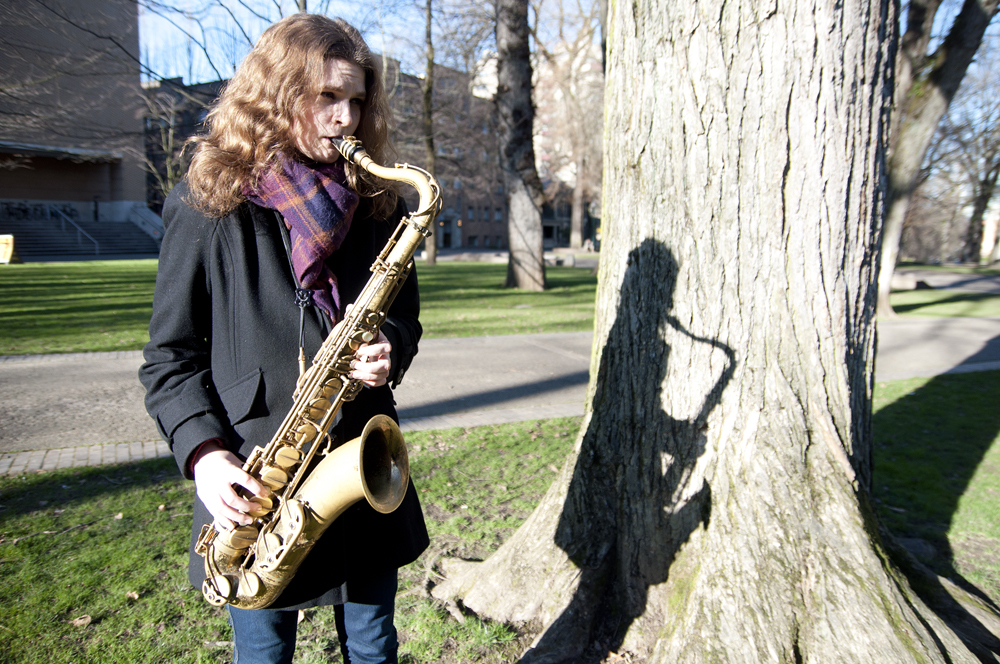
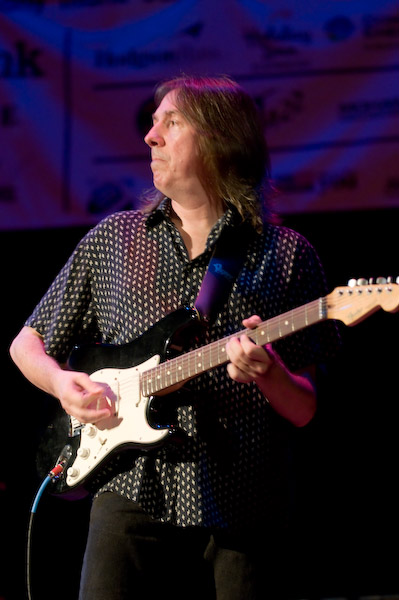
I had a great weekend down in Eugene; I was mainly there to give a clinic/lecture for the OMEA(Oregon Music Educators Association) Convention. However, I also got to play music to nights in a row at The Jazz Station, a really nice local venue. The first night was I was playing piano with saxophonist and legendary educator Steve Owen. We played some of Owen's originals and arrangements with Eric Gruber on bass and Jason Palmer on drums. The second night Jason Palmer and I worked with tenor saxophone monster Joe Manis. I was playing Hammond Organ instead of piano; both nights were fairly intense, and there were good crowds who were very enthusiastic.
It was a really nice weekend overall; the gigs were good, the clinic was fun, and I got to see Jason Palmer give his clinics, which were quite impressive from an educational standpoint. I also got to see a little more of Eugene than in times past, including the music facilities at
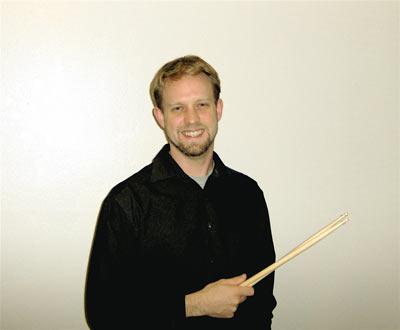 |
| Jason Palmer |
the University of Oregon. Before my gig on Saturday night, I got to hear the U of O Jazz Ensemble a bit( in addition to some of the Oregon All State Jazz Band). They were very impressive. Steve Owen has a heck of a program. Indeed, as part of my clinic, I was able to work with some of the top U of O students, and they came ready to play jazz on a high level.
My clinic ended up being somewhat extemporaneous; however, I actually wrote many ideas down in speech form, and I decided to print it hear for those of you who missed the clinic.
 |
| Steve Owen |
Musings On Jazz In Our Schools
Jazz is America's Classical Music. We don't have to debate this. However, Jazz still has to struggle for attention. The days of jazz as America's Popular Music are long gone; Jazz is not part of our cultural vernacular. Whether it's watching TV, or going to the movies, or going to a restaurant, or listening to the radio, the chance that you might hear jazz is very low. Live jazz performance in America is not as commonplace as it has been in the past. In some ways, it is thriving more in the educational realm. Even when it is established as a real part of a program, whether it be large or small ensembles, improv classes or Jazz history classes, jazz still struggles to be understood. As a freelance musician based in New York for about 15 years, I always found it odd that Jazz seems to have far more legitimacy in Europe and Japan than in the United States.
The more I teach at the college level, the more I wonder about what's going on before kids get to college. Obviously, there is something going on; even as the idea of a career in jazz becomes more precarious by the year, we still get plenty of folks at Portland State University who want to make it their life's work. Not to say that everyone who is in jazz band should go on to major in music; however, jazz in the primary and secondary schools are crucial not only for future jazz majors but also for future jazz listeners, which we who perform desperately need! Almost every gig I play in Portland, someone will come up to me afterwards and say, "Man, I enjoyed that set! I used to play in my high school jazz band." My point is that professional musicians as well as college jazz professors owe a huge debt to the high school, middle school, and elementary school band directors.
I have spent most of the past 20 or so years as a freelance jazz pianist; however, my training was in classical trumpet and music education. Back in 1990, I was fortunate to do my student teaching under Barry Enzman at Glenelg High School in Howard County, Maryland. I think many of us would be envious at the success of Enzman's program; basically, the band program WAS Glenelg HIgh School! All the other teachers worshipped Enzman; I would eat lunch with him in the faculty lounge, and the conversation would always seem to shift towards the band program, without provocation from Mr. Enzman. His Jazz Ensemble was the best in the county, probably even in the state. I asked Mr. Enzman how he had such a great program; his response was naturally-"The feeder schools!" Music students pined for the Glenelg High School program from middle and elementary schools- maybe even from birth!
As a middle school and high school student, I idolized my band directors. My goal was to follow in their footsteps. Mostly by accident, jazz piano took me in another direction for many years. However, I can't help but wonder about what place Jazz has in a Bachelor's in Music Education or a Master's in Music Education these days, more than 2 decades after I got my Bachelor's from Peabody Conservatory. Judging from the Reno Festival last year, jazz groups at the high school level, large and small, are thriving! However, my guess is that, what with methods class, practicum, conducting, pedagogy, and more, there just isn't enough time to spend on jazz in your average Music Ed program. So I would like to offer some suggestions for band directors who have questions on how to improve your jazz band.
1. Be Positive! You or your students may have a lot of questions, such as, "Who was Theolonious Monk, and why did he write such quirky music?" Or " What is swing?" Or, " What does C7b9 mean?" Or " What is a rhythm changes? And when does the "rhythm"change?" Be positive; don't be discouraged if you don't know the answer, or if your students never heard of Coltrane, let alone Michael Brecker. It's not their fault, and it's not your fault. As I said previously, Jazz is not ubiquitous; therefore, it's something that has to be sought out. There is a lot to know, but thanks to the internet, it is actually much easier to find the answers. However, resist the urge to say things like, "Wow, you never heard of Bud Powell?" Or "Wow, you really need to check out some Max Roach!" Also, resist the urge to beat up yourself in the same way if you are unfamiliar. Life is about learning. The more we know, the more we realize we don't know. We need to welcome the process of learning, which means possibly feeling ignorant for a few seconds. If you can get past the embarrassment for yourself, or the urge to condescend to students, you'll have a better time, everyone will learn more, and then everyone will be enthusiastic about learning, because they will see the results of the process, rather than the side effect of negativity. Remember, no one should feel bad about NOT knowing something about jazz. Indeed, there really aren't any good reasons in this day and age why anyone SHOULD know anything about jazz. ( I remember the first time I played with drummer Billy Hart in Washington D.C. in the early 90's. He made a point to ask me, " Why are you DOING this? What made you decide to get into jazz?" He was really curious, if not completely baffled as to why a young kid from a Maryland suburb would want to play this music.)
2. Listening is key. I like to say that the biggest problem with jazz is that you actually have to listen to it! I'm joking of course, however, one thing we must remember is that much of the true element of jazz does not exist in the written music. The blues and spiritual elements which New Orleans musicians brought to European instruments is what is so fascinating about this music. It's as sophisticated as it is street. The street elements-swing, groove, inflections, phrasing, improvisation, interaction, rhythmic feel,sound, articulation-these are very hard to understand if time is not spent listening. I believe that what really inspired me the most as a youngster was a summer Music Appreciation class I took when I was in middle school. During the class, there were two recordings which completely blew me away: Clifford Brown's "The Beginning And The End", and Herbie Hancock's "Headhunters." I ended up signing these two records, among a few other records, out of the library countless times. I would listen to them over and over. Then, a neighbor down the street heard I was into jazz, and he "lent" me a handful of recordings, including Miles Davis "Milestones," Dizzy Gillespie "New Wave", Art Farmer and Donald Byrd "Trumpets All Out," and Clifford Brown and Max Roach "Joy Spring." I wore these recording out, as they say.( My neighbor never got his records back, by the way.)
Again, the internet alleviates the need for walking back and forth to the library; we can access almost unfathomable amounts of music on youtube and spottily for free. If you choose to support the industry, you can download almost anything on iTunes without leaving your home. Some educators believe that, in a way, because of the easy access to so much music of all genres at the touch of a button, students either completely take it for granted, or they "skim" content, never really absorbing anything. This might be true. Be that as it may, I believe that this access to material, if used wisely, can open up a whole new world of advantages for jazz enthusiasts and jazz educators everywhere. When you consider that one youtube video can lead you in many different directions, think of it this way; you may have a student who says, " I want to get into jazz. Where do I start?" Well, how about start with Miles Davis? Miles will lead you to Coltrane, but it might also lead you to Charlie Parker. Charlie Parker might lead you to Lester Young, but he might also lead you to Dizzy Gillespie. John Coltrane might lead you to McCoy Tyner, which might lead you to Elvin Jones, which might lead you to Dave Liebman, which might lead you to Richie Bierach. But McCoy Tyner might also lead you to Wayne Shorter, which might lead you to Esperanza Spalding. Dizzy Gillespie might lead you to Stan Getz, which might lead you to Joao Gilberto, which might lead you to Antonio Carlos Jobim. My point is, it only takes a little bit to lead us down a path of discovery.
3. Anyone can improvise! Yes, I realize that this is jazz education icon Jamey Aebersold's catchphrase! I am not a paid endorser of Aebersold products. However, I do believe in his play along method. But we shall come back to this. I believe that most musicians who don't attempt to improvise do not do it because of lack of skill or knowledge. They don't because of fear. We are afraid of sounding bad. Unfortunately, even when we do learn a lot of skills and information, and we progress in many areas of music, we still get hung up by fear. There are a lot of things to be legitimately afraid of- natural disasters, nuclear fallout, Adam Sandler movies, and so on. But we should not be afraid of playing music. The most important thing from beginners to professionals is to have a good feeling about making music. Negativity is what makes even the most talented music students quit before they realize their potential. This doesn't mean we should never be critical. But we need to be encouraging. We should also realize that "SOUNDING BAD" is actually part of the process. So, when we begin to improvise, whether it's just playing without sheet music, or playing on a blues, or playing along with an Aebersold, or playing a solo in a big band chart, we should embrace the process rather than the result.
I believe that it is only natural for band directors to emphasize arrangements and ensemble playing over improvisation because it is much much easier to present written material at competitions and winter concerts. I agree. However, don't procrastinate. The earlier that kids get comfortable with improvising, playing by ear, and experimenting on their own, the better. It's all about putting the fear away. The only reason I took solos in my high school jazz band was because I was the only one that volunteered. And believe me, I sounded HORRIBLE! I had no idea what I was doing. But I wasn't afraid. if I hadn't taking the risk of walking out and playing a flugelhorn solo on "Tomorrow" (from "Annie "), I wouldn't be where I am today.
I realize that rehearsal time is precious. Well, concert bands warm up with scales. Why not warm up with jazz scales? Go beyond major- harmonic minor, dorian, blues scale. Why not warm up with a blues where everyone in the band gets a chorus or two? I believe at this level it's about inclusion, not exclusion; give EVERYONE a chance.
4. Conducting a jazz band is easier than you think. This might be obvious to some, but you'd be surprised that there is really tendency to OVERCONDUCT a jazz band. However, if you think about Count Basie, Duke Ellington. Maynard Ferguson, Buddy Rich, Dizzy Gillespie, Thad Jones, on so on, they were mostly playing, not conducting. They might give a lot of cues, or indicate dynamics, but it's surprisingly minimal. The tempo comes from the rhythm section. It may be a challenge for your students to shift from the "follow the conductor" concept of the Concert Band versus the "listen to the rhythm section" vibe of the jazz band. This is where warming up on a blues or a standard might also help- so that students can get used to LISTENING while they play.
5. A good rhythm section is invaluable to your big band. This is why they should also play together outside the group on fake book tunes; so that they can learn how to play together and how to go beyond what is in the chart. I realize that, especially when working with more beginners, that it might be completely necessary to stay with the written material. But oftentimes, the more you will get away from the written material, the better. I will come back to this, but everyone in the rhythm section should think like a drummer. What I mean by this is that the more the bassist and pianist, and even guitarist focus on rhythm above all, the better the groove is going to be.
There are some common pitfalls for rhythm section, which include:
A. Drummers pick terrible cymbals for the ride cymbal. The ride cymbal is the most important cymbal for your drummer. You might need to spend a little bit of money. I t also might be worth it to find a pro drummer in the area and get him to help to find a cymbal or recommend something. I would say something in a 20 to 22 inch, something dark sounding , hopefully not too washy but with enough sound to create intensity. Too dry can be perhaps too revealing and ends up being too harsh. I personally love dry cymbals, but you need a really good drummer to make it work. Also, don't worry about rivets; one of those "chains" can work fine for a ballad.
B. Young drummers, particularly those who don't listen to swing music, tend to overemphasize one and three on the ride cymbal. If you can get them to flip it, everything will sound much better. It doesn't have to be hard accents on two and four, but the primary emphasis should be on 2 and 4. Basically, the drummer should be able to sound great WITHOUT the help of the hi hat.
C. Upright bassist who come from playing electric oftentimes have a incorrect hand position, especially in the left hand, which if left unsupervised, can cause tendonitis. I believe that that might be one are where at least one lesson with a professional would be crucial. Don't necessarily force your electric bassist to play upright just because there is one in the band room. Electric bass is fine for jazz, in some ways, better because it's more practical in terms of traveling. Plus, you can hear it! You might have to help them get the proper eq for walking lines.
D. Bass players should try to get past the written bass lines and improvise using the chords and scales as soon as possible. This will help with the time. As I said before, the bassist is like another drum, and he needs to worry most of all about hooking up with the drummer, particularly the ride cymbal.
E. Oftentimes, the pianist in your jazz band comes from a classical background, and unlike the rest of your band, they might not have any concert band or even any group experience at all. Again, you want to encourage them to listen to the rhythm section, and to the band, and not to get bogged down in reading the chart. Although there might be key things that they need to play verbatim, much of the piano parts are obscured by everything else that's going on in the band. One thing you might encourage is to play the written voicing but play different rhythms.
F. There is always the question of " if the pianist is comping, what does the guitar do?" Well, that's a great question. Aside from the "Freddie Green" thing, which is quarter notes kind of "chunking" along, there are a few options. Piano could play for a while, then guitar, so essentially, they totally stay out of each others way. Another approach is to compliment each other; if the pianist is playing big chords, the guitar could play single notes. If the pianist is playing slow moving chords in a sustained fashion, the guitar could play more rhythmically with more space. It's definitely an area for experimentation with listening to each other.
G. It's very common for the entire rhythm section to be confused about the differences between Latin(Mambo, Salsa, Afro Cuban) and Brazilian( Samba, Bossa) grooves. Latin grooves tend to be based on either a 2/3 or 3/2 clave, whereas Brazillian is not as static in terms of a clave; it might use what's called Partido Alto, but it's a very different rhythmic approach. I would recommend listen to Eddie Palmieri, Tito Puente, and Ray Barretto for Latin music, and Antonio Carlos Jobim, Stan Getz, and Joao Gilberto for Brazillian music, just to start.
H. I would give as homework to each member of the rhythm section the assignment of 3 legendary musicians on their instrument to listen to. Again, youtube guarantees it's a mere finger click away. I picked three who are known as great accompanists.
Piano- Red Garland, Wynton Kelly, Herbie Hancock
Bass- Ray Brown, Paul Chambers, Ron Carter
Drums-Max Roach, Philly Joe Jones, Elvin Jones
Guitar-Freddie Green, Joe Pass, Jim Hall
6. I love all kinds of music. But if I had to be very general about the difference between the jazz aesthetic and the European Classical aesthetic, it's that classical musicians will fudge the time in favor of note accuracy. Jazz musicians, because we are listening to the rhythm section and playing in a GROOVE, will fudge the notes to make the "time" feel good. If you use this philosophy, I believe you will be surprised with the results. Especially when it comes to improvisation, but I think even when we are dealing with ensemble passages, you want it above all to "feel good." Indeed, I'm proof of this idea; when I first started playing gigs on piano, I had no technique, and I only knew a few songs, and I couldn't really read piano music. But because I had done a lot of listening, and because I had played trumpet along with Aebersold records for so many years, I knew by ear what good comping was supposed to "feel" like. So I got hired.
My last thought about the Aebersold series is that I prefer them over the irealbook for the main reason that the irealbook is very computer stiff sounding, whereas the Aebersolds give you the opportunity to play along with the feel of REAL jazz musicians like Ron Carter, Ben Riley, Billy Hart, Kenny Barron, etc…I was in New York for 15 years and I never got to actually play with Ben Riley or Ron Carter….except that I sort of got to play with them every day in my apartment in Baltimore while I played along with the Charlie Parker Aebersold volume! I think it's a really great and fun practice tool; indeed, you can work out your ideas in real time and learn how to play forms and how to swing and so forth with master rhythm sections who never get tired. ( I asked Randy Brecker how he keeps his chops up and he said he plays with Aebersold recordings every day.)
As I mentioned, not every member of your jazz group will go on to become a jazz major, but perhaps having a great jazz program will give them a lifelong interest in jazz and other forms of music. I believe that jazz can offer a creative outlet that arguably playing in concert band may not. This is not to devalue concert band, or reading great charts. I just believe that we should encourage the creative process wherever possible. I believe everyone should be creative. Everyone should write a song if they want to! It's not a matter of being great! It's about being expressive and about self discovery. It is about personal growth. It's not about competitions. Don't be afraid of the unknown. It will never be known unless you search for it.