One of the downsides of playing a lot of gigs with my students has been, you guessed it, that I'm no longer the youngest person in the band! In all seriousness, I have been very fortunate to be able to learn jazz, mostly on the bandstand, from older musicians who had way more experience than I. Indeed, my very first steady gig was at a the Hyatt Regency in Baltimore, MD, with saxophonist Phil Burlin and bassist Larry Kindling; it was supposed to be MY gig, but they were the ones showing me what to do, being at least a decade older. This is part of the jazz tradition in terms of jazz being a folk music, the art form being passed down to future generations by master practitioners. It's wonderful to be part of a great music curriculum and have classes and have a college experience. However, when you are on a stage and Gary Bartz starts playing a song you don't know and expects you to figure it out, that is a very different kind of learning process. In the real world of music, there are no letter grades- only "PASS" and "FAIL."
Victor Bailey
So when I get a surprise call to join three elder masters on stage at Jazz Alley for four nights, I get not only the thrill of feeling like the young'un on the bandstand, but I also get the thrill of learning through doing. In some ways, playing jazz has infinite variables. You cannot say, "OK, I have learned 60 tunes from the Real Book and transcribed a lot of solos and learned all of my scales and modes and I practiced with a metronome so I'm ready." Every grouping of musicians is going to present different challenges; every combination of bassist and drummer is a different feel than another. It's almost like saying your metronome is going to be different every day you turn it on.
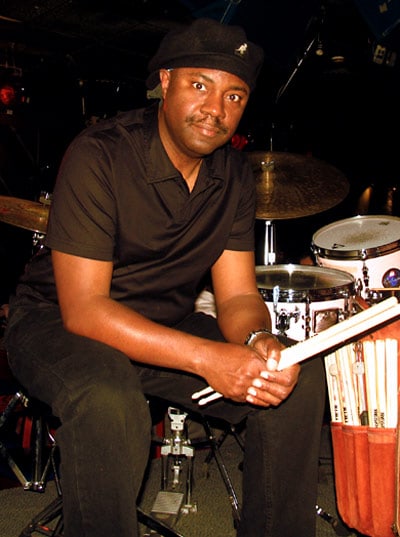
Lenny White
It's especially challenging walking into a situation where you have three legends who have been playing together for decades, and your presence, even if promising, is possibly superfluous. Nevertheless, my first night with jazz fusion legends Lenny White, Victor Bailey and Larry Coryell was extremely positive.( I think it should count towards a Doctorate of Musical Arts. Can I get college credit for this?) We played a mixture of originals by Bailey, White, and Coryell( I had to sightread a tune call Spaces Revisited, which was fun-good thing I went to Peabody Conservatory!). We ended the set with a great arrangement of Led Zepplin's "Black Dog." Hopefully I can continue to learn and imrpove as the weekend continues.
These men aren't just practitioners of the art- they ARE the art!
We have three more nights: two sets Friday and Saturday and one set Sunday. Come down if you are in or near Seattle.....
Drummer and Record Label Entrepreneur Matt Jorgensen is a Seattle native who lived in New York for a number of years before moving back and settling in Shoreline, Washington. I've known Jorgensen for over a decade, and since my arrival in the Pacific Northwest, we've gotten many opportunities to work together. I also got to record for his label, Origin Records, which is one of the best indie jazz labels in the world. I recently sat down with Jorgensen to talk about how he got started and his thoughts on music and the jazz biz.
GC:
What are your earliest memories of music?
MJ:
I started out playing piano in the first grade. My mom always wanted to play
and we had one at home. Then there was a kid who would babysit me when I was
around 8 and he would bring over records or browse my parents’ collection. My
mom had lots of Beatles records and the White
Album was my first musical exploration. I’dlisten to side after side, transfixed. High school was the
next musical era for me. Freshman year I started drum lessons with John
Bishop.The next year, I began playing in marching band, concert band and formed
a rock band with my friends.
GC:
How did you get into Jazz?
MJ:
My senior year of high school they started a jazz band at the school. I can't
lie, it was awful and Ilater, he went to the New School and
convinced me to go with him.
didn't really know what I was doing. The summer between
high school and college, my Dad signed me up for a Tuesday night community big
band at Shoreline Community College where I was planning on attending that
Fall. I went to the first rehearsal only able to play a swing beat and that was
it. The band director Jeff Sizer came to and said, “I can pretty much tell you
don't know what's going on.” He summed up, from a director’s standpoint, how to
play big band drums in 4 minutes. I called John Bishop for a crash-course
lesson on reading big band charts and spent the summer practicing. In the fall,
I auditioned for the big band [for music majors] and got in. I met a bunch of
musicians; one of them was bassist Tom Abbs. A year and a half
GC:
If you decide to go to the New School, people there KNOW they're going to be a
jazz musician or at least try. Where in your short amount of time did you KNOW
you wanted to do that for your life? Or did you have no other option like the
rest of us?
MJ:
Looking back on it, I don’t really know. It’s funny, I've always been really
driven on certain things and music became one of those things. And it slowly
became what I did.
GC:
That was your identity.
MJ:
Yeah, I don’t know if it was set yet though. My friend Tom went to New York and
I tagged along because that sounded like fun. I auditioned for both William
Patterson and the New School but was waitlisted for both. I already committed
to moving to New York though and Tom got an apartment on 30th and Lexington. I
moved there two weeks before the term started at the New School and showed up
to update my address. Fortunately, a spot had opened up and they let me in.
When I went in for auditions at the school, I got placed in one of the higher
up combos. The summer between my audition and the start of school I had started
to figure out what I was doing on the drums. Then meeting all the great
students at school, playing in groups, it was exciting and new. After a while
it [music] was just what I did.
GC:
You didn't graduate?
MJ:
No. I had a certain amount of money saved up and I knew if I went there part
time, I could get through two years before it ran out. My mission in school was
to meet people, play, and be in the city. I knew when I was about to go that I
wasn't going to graduate. Then I stayed in New York, played gigs and took odd
jobs.
GC: How long were you in NY?
MJ:
10 years from 1992-2002.
GC:
And we never played together.
MJ:
No, that was after I moved back to Seattle. Pretty much everyone I work with
now on gigs, with Origin or the [Ballard Jazz] Festival, I met during the time
I was in New York and the New School. I've always said to kids who are in
school that you need to meet people and be active because throughout your
career you maintain relationships with all these people.
GC:
Do you regret not having a bachelor's degree? Do you think it's important?
MJ:
Part of me wishes I had finished, but I don't teach and I don't envision myself
teaching. I'm not going to get fired from Origin Records for not having a
Bachelor's degree! But, if it was my kid, I'd say, “Yeah, you should finish.”
But everyone will have their own path. One of my friends wanted to be a
musician and when he was young his mantra was, “do anything possible you can to
be a musician.” For him that translated into living as cheaply as possible and
doing whatever it took to get by and keep making music. Since school is so expensive
now, I don’t think it matters if you go to one of the most expensive schools. I
went to Shoreline Community College for two years first, which had an
incredible music department. If it wasn't for the band director, Jeff Sizer, I
wouldn't have a career in music. He showed me so much.
GC:
Let's talk about drumming. The first things I hear when I listen to you play is
Philly Joe, Jimmy Cobb, and Bill Stewart. Who are your top 5 drum heroes?
MJ:
Everyone you mentioned are my heroes. If you asked me top 5 of yesteryear it
would be Philly Joe, Jimmy Cobb, Elvin, Tony Williams, and Arthur Taylor. If
you asked me today it would be Bill Stewart, and Brian Blade. Also, I've
listened to a lot of John Bonham and Keith Moon-
GC:
And you've listened to a lot of Ringo Starr.
MJ:
[Laughs].Bernard Purdie andMotown records. The big thing for me,
which didn't happen in Seattle but did in New York, was that people hung out
and listened to records. As a drummer, it's important to listen to as much as
you can. People who play chordal instruments learn the changes, while drummers
learn the arrangements and song forms. So if you're playing Moment's Notice, which version of the
first two bars are you going to play? And knowing the different arrangements on
different records by different guys is important. I was lucky enough that John
Bishop was my instructor in Seattle. Before I moved to New York, I read an
interview with Kenny Washington in Modern
Drummer about him being a hardass as a teacher. I looked at the New School
faculty and saw he was on the list. My first semester there I called him up
told him I wanted to take lessons from him. People told me that I was crazy and
that he was super tough. Kenny was really cool but very demanding that you do
the work and listen to the records. He has an amazing record collection and an
encyclopedic mind. But what stuck me was that he was teaching me what John
Bishop had been teaching me, I just wasn’t ready for it yet.
GC:
Do you think that some of the trends in jazz education are leading kids away
from listening to records and having things under their belt to execute? Do you
think jazz is moving away from that [listening] tradition? Is there a way to
move jazz forward without chucking the tradition away?
MJ:
I think there are different ways to approach it, depending on what instrument
you play. As a horn player, you're usually out front leading groups. As a
rhythm section player, you're hired by a lot of different people to be a
sideman and you need to be familiar with a lot of music history as well as
different ways of playing. It's tough because there's so much music to check
out and you need to do it or else you limit yourself to only playing certain
gigs. I've done a gig where it's bebop one night and the next night is John McLaughlin
fusion stuff where I was playing like Billy Cobham. You need to move from gig
to gig; I personally like to be able to play the music in a way that would be
appropriate. There's no real substitute to listening and checking out the
music. It’s like explaining a foreign language, right? You can learn French
from a book but until you hear it spoken, you're not going do it right. You can
learn music by the numbers, but until you hear someone else and see them play- that's the most important part. When I
was in New York, Arthur Taylor, Max Roach and Elvin Jones were still alive and
I got to see how they execute things I've heard on records and that always gave
me new things to practice.
GC:
You also said you've been inspired by fellow-students like Joe Strasser, who
was maybe more advanced than you at the time. Do you think it's really
important to draw inspiration from the people around you?
MJ:
When I got to the New School I was just amazed at the level of drummers and I
also realized there was a lot I needed to learn. My first semester I show up
and there was Joe Strasser, Stefen Schatz, Ali Jackson, Chad Taylor, Brian
Floody, and I think Adam Cruz was there or he had just left. But there was
always a cool vibe between everyone. I remember hanging at Strasser's place and
talking drums while listening to records I'd never heard. Watching Strasser and
seeing how he comp'd was different than what I was doing, so I applied what he
and others were doing and it opened up my playing. I also took a couple of
lessons with Bill Stewart - he’s so creative how he works an idea to the
infinite possibilities and he got me thinking more creatively.
GC:
Do you miss New York?
MJ:
Certain parts for sure. I like going back and playing but I knew after I’d been
there for just a couple weeks that I wouldn't be there forever. It changes you.
There are certain things I miss, but there are a bunch of ex-New Yorkers in
Seattle and we commiserate. The thing I miss is the consistent high level of
playing. You’re also able to call some of your musical heroes to see if they
want to play a session. You have to be the best all the time there, or else
there are people who will take your gig out from under you. When everyone is of
such high caliber, it naturally brings you up to that level.
GC:
Ok so you came back to Seattle and what happened then?
MJ:
In 1997 John Bishop started Origin Records when there were five different
projects he was involved with where he both played drums and was designing the
album cover. He decided to put the recordings under one record label. I was
talking to him on the phone and told him I was getting into building websites.
At the time, I had a project that I was doing with saxophonist Alex Graham,
pianist Whitney Ash, and Gary Wang on bass. We had a CD we were going to put
out and I traded doing the cover art [with John] for doing the website and that
was the start of my involvement with Origin Records.
By
2002 the label was building a lot of momentum. I moved back to Seattle and we
got our first office. John and I were doing everything for the label and in
2003 we started the Ballard Jazz Festival. From there we've been doing the same
thing every day and everything keeps growing.
GC:
How do you balance the music with the entrepreneurship? You were saying last
night that it's a new thing for musicians to be doing everything. How do you
negotiate that?
MJ:
We started doing everything for ourselves because no one would do it for us. I
think the balance for us is we do what it takes to make the music happen. If
guys are coming through town, I usually help set up some gigs and make a tour
happen. We had an opportunity in front of us with an organization that wanted
to put money behind the Ballard Jazz Fest and we reverse engineered what it
would take to make the festival happen. Once things get going for us, it’s hard
to stop. I don’t know if I truly have balance between the two but I do the
record label and festival stuff to be able to make music. For me there’s no
real line between the business or music side, it all goes hand-in-hand.
GC:
Do you think that’s the way of the future for all musicians?
MJ:
Unfortunately I do and I tend to think that’s not a good thing. There are
people that have specialties in all kinds of things. Look at Spike Wilner who
is an amazing piano player and had the opportunity of taking over Small’s. What
he’s done with it is great. Not all of us can do all of those things well.
GC:
Or do them well. I know for myself, sometimes it’s like I need to slow down and
focus on one thing but it’s life in the 21st century. You can kiss
goodbye the idea that you can do anything well because there’s so many things
that need to get done.And nobody
is going to do them but you.
MJ:
Yeah and I think the danger in that is you’re going to burnout. For years there
were record labels and radio promoters and now that’s all fallen on independent
artists. Those artists don’t necessarily have all the experience or know how to
do it. Fortunately with Origin, we have 16 years of experience and we know how
to get from point A to point B. There has been a lot of frustration along the
way, as well as success, but I feel fortunate to have John Bishop to share the
burden of the business side.
GC:
When you and I were coming up, everything was compartmentalized. I came up at a
time where people that put out their own records were seen as going around the
system and couldn’t get on a label. It telegraphed that they couldn’t make it
in the real world. Now, no matter how good you are, from bottom up, it’s a
completely different story. Sonny Rollins has his own label. Artists you’d
never think would have to do [independently release] are. With me, coming from
this era and transitioning to the new era it’s hard to catch the new paradigm.
If you present this new paradigm to young musicians from the jump, do you think
that will yield better results?
MJ:
If you’re teaching music business in a college course with a textbook that’s
more than 2-3yrs old, you’re teaching useless info. Things are changing all the
time and I don’t know where things are going to be filtering out in the next
couple of years. I don’t know if everyone can do it all. Sometimes I just want
to write tunes or play the drums and not do all of this other crap. But you
can’t now. I don’t know what the answer is. Part of it goes into technology.
You can pay $5 a month for Spotify or $0 for Spotify and have commercials. As
musicians, we should have conversations about giving away our music for
fractions of pennies. Overall, the amount of money we’ve gotten paid has gone
down and the infrastructure has gone away. Is that good? These things are not
set in stone and there are discussions about royalties. If Spotify can charge
$5 a month for music, then as musicians we should decide what a fair wage is
and demand it. I think the future is obviously in flux and it’s changing week
by week, month by month. If we’re churning out these kids in jazz school and
not making them aware of what the future has in store for them, we’re doing
them a disservice. Music business class in college needs to be rewritten every
year. But I also think kids need to know that while there are a lot of avenues
to market yourself, I keep coming back to rule number one: sound good on your
instrument and do everything possible to make the music happen.
It's always great to hear live music, and it's always a privilege to get to hear one of the greatest musicians to ever walk the planet give a concert in one's hometown. One of my true heroes, Herbie Hancock, brought an all-star quartet to Portland's Arlene Schnitzer Concert Hall last night. It was not sold out, but close to full, and as Mr. Hancock alluded, the "vibe" was great. I think oftentimes, jazz concerts in big halls fill up because of name recognition, regardless of whether anyone knows an artist's work. I think it would be hard to find someone at last night's venue who hadn't at least heard "Chameleon," or "Rockit," or at the very least "Watermelon Man."( Actually, some people walked out rather early; they may have been expecting something more in the "traditional jazz" vein.)
Hancock's ensemble featured the great Lionel Loueke on guitar and vocals, who almost stole the
Lionel Loueke
show with a solo feature where he used effects pedals to make it sound as though he could use his single voice to make the sound of a West African choir. James Genus, one of the great bass players in jazz and fusion( if you have seen Saturday Night Live, he's sitting in the band on stage left during the opening monologue) was holding it down on electric, but also took some beautiful solos. The drummer, Vinnie Colaiuta, is arguably one of the greatest drummers ever in history. (Hancock alluded to Colaiuta's regular gig with Sting by saying, " he has a day job!")That being said, when the quartet opened with "Actual Proof," one of Hancock's classic tune from the 70's album "Thrust," I found myself missing drummer Mike Clark's raw Oakland funk and jazz vibe rather than the slick fusion vibe of Colaiuta. Again, don't get me wrong, few can play with the combination of precision and heart the way Colaiuta does.( I actually recorded with Colaiuta on a Richard Bona album called "Tiki.") Later in the concert, Colaiuta did some ferocious displacements on a funky version of "Cantaloupe Island."
Vinnie Colaiuta
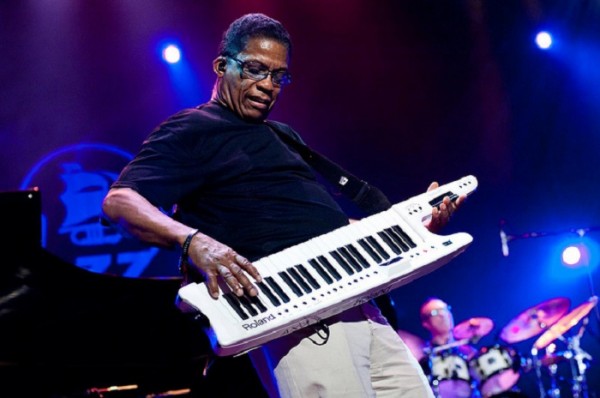
Hancock, who I believe is 72 years old, had more energy and enthusiasm on stage than most of my students! He still plays the piano with so much reckless abandon, and also switches easily between acoustic piano and electric keyboards. He jumped around the stage with his keytar like the lead guitarist with a hair band! It was definitely a fusion kind of event, although a solo piano intro to "Speak Like A Child" (which seemed to be in three keys at once) was definitely worth the price of admission( which surprisingly was only $35 dollars each for us!). In a time when we are losing a lot of the older masters, it's nice to know that Herbie Hancock is still out there playing with the spirit of a teenager.
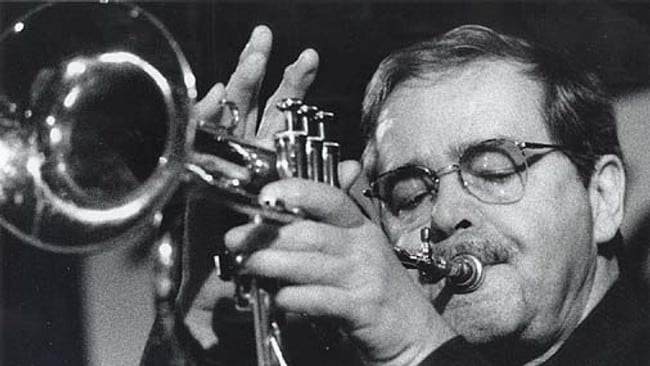
We've lost a number of greats in jazz recently( Charlie Haden, Joe Sample, Horace Silver, Gerald Wilson), but I wanted to mention the death of trumpeter and composer Kenny Wheeler. A huge influence on many modern musicians, Wheeler had an unmistakable trumpet sound as well as a distinctive compositional style. I was fortunate to study with him at the 1990 Banff Summer Jazz Workshop. Wheeler, humble to a fault, and quite a contrast from artistic director Steve Coleman, was incredible to be around. I was fortunate to get play in the trumpet section in the rehearsals for his Large Ensemble suite.
I remember signing out "Deer Wan," one of Wheeler's classic records from the library in the early 80's. I believe for most musicians, "Gnu High" is a standout recording( I found it ironic that pianist Allyn Johnson had just received his copy of "Gnu High" on vinyl in the mail on the same day of Wheeler's passing.) Some of Wheeler's tunes than are often played include "Everyone's Song But My Own," " For Jan," "Smatter," and "Consolation." Indeed, listening to a bit of "Smatter" gives me chills...
I remember two things about Mr. Wheeler at Banff. He coached my ensemble( I was playing trumpet back then), and during the rehearsal, I left to use the bathroom. When I returned, Wheeler was in my spot, reading the chart( it was an arrangement of his tune, "Mark Time." When he saw me, he demurred the spot to me. But I looked at him and said, " No, you can play!" He shrugged as if he was completely unworthy. He then proceeded to take a trumpet solo that just obliterated! There was another moment when a student came in who didn't recognize Wheeler. He was just sitting in a chair, looking extremely unassuming. " Oh, are you auditing this class?" she inquired. " Oh, actually I own all of these facilities, " he said in a quiet deadpan. " I'm Mr. Banff!"
I've been traveling to the continent of Europe to perform jazz since 1993. Back then, the excitement of new countries and new experiences vastly outweighed the discomfort of air travel and the harsh realities of jet lag. Over twenty years later, the thrill of sitting in a tiny seat for hours and having very irregular sleep patterns has obviously diminished. Still, it's great to be able to travel to places where jazz is really appreciated and to see old and new friends. As much as I enjoy teaching and having a steady job, I am determined to keep a foothold in Europe or wherever else I can perform my music on a semi-regular basis.
I just returned from the first European tour that I totally set up by myself. I've toured Europe countless times as a sideman, and I've done a few tours as a leader with the help of promoters. However, it's very difficult to book your own tour; there are so many logistics, and even on a very short tour like this one, I found it challenging to keep track of everything. Although I wished more gigs had come through, more gigs can also mean more opportunities for something to go wrong! Be that as it may, it was a little over a week long and I would view it as a success, and hopefully the start of some momentum to help to do more next time.
My tour went to four countries. My first stop was in Iceland. This was the only place on the tour
Harpa in Reykjavik
where I had never been before. Reykjavik is a beautiful, serene city; the weather was a bit rainy and gray, but I was able to do some running along the coast and through the town. I did a workshop in FÍH (Tónlistarskóli Félag Íslenskra hljómlistarmanna/Music School of the Federation of Icelandic Musicians) which was well attended; I got to play with some young students and it was a very positive experience. I also gave a trio concert at Harpa, a gorgeous arts center in downtown Reykjavik. The event was sponsored by Múlinn Jazzklúbbur (Mulinn Jazz Society). Scott Mclemore, a great drummer and friend from the Brooklyn days, has been living in Iceland with his wife Sunna Gunnlaugs( Sunna is a great pianist) for almost 10 years. I'm thankful that he hooked up the clinic and the concert. We had a great trio vibe, rounded out by Toggi Jónsson, a wonderful bassist from Reykjavik,
which made for a great concert. I wish I could say that I got a chance
to sample some typical Icelandic food; actually, we ended up eating the
amazing cooking of Sunna Gunnlaugs almost the entire time I was there.
Gunnlaugs is a great cook; she is really focused on healthy meals.
Malmo, Sweden
Next, I flew to Copenhagen, then took a 30 minute train ride to Malmo, Sweden for a clinic at the Malmo Academy of Music. This was my third visit to the Academy, and it's a great atmosphere; the students are curious and have a positive attitude. This event was coordinated by Hakan Rydin, who is the jazz piano professor at the Academy. It's great to work with students who are serious about the music. I played a few of my originals in trio with the students, then we worked with a vocalist for a while. I was amazed at how 4 hours just seemed to fly by! The next day I headed back to Copenhagen for a gig at the Jazzhus Montmartre. This is the famous Montmartre where expats like Dexter Gordon performed often. My trio was two of the top Danish jazz musicians; Morten Ramsbol on bass and Morten Lund on drums. After a quick soundcheck/rehearsal, we did two magical sets of original music and
Jazzhus Montmartre
standards for a decent and appreciative crowd. ( It's worth noting that for both the Copenhagen gig and the Vienna gig that I had at least one person waiting for an autograph. I tell my students that I'm famous but they don't believe me!) The night was marked by two more things; one, the piano at the Montmartre was an incredible Steinway-perfectly in tune and action like "butter." Two, the great pianist Eric Reed, who was in Copenhagen working with the Alvin Ailey American Dance Theater, came by to hear the music. It's always nice to have some of the "cats" in the audience.
Porgy and Bess, Vienna
My final stop was in Vienna; I feel lucky that I had a chance to play at Porgy and Bess, which is one of the best jazz clubs in Europe. We had a great crowd, and the energy of the trio with Ramsbol and Lund was even more intense than in Copenhagen. It was surprising that the sympatico was so good considering we had never really played trio before ( although we worked as a trio accompanying vocalist Sinne Eeg a few years back). I'm hoping to do some more with this trio next year. Now, back to Portland and my work at Portland State University. Since I'm teaching more now, touring Europe feels different than it did back when I was touring 6 months out of the year; it feels almost like a "jazz vacation." Hopefully next time it will be a little longer.......
I realize it's still a bit raw, but I wanted to express my disappointment at the news tonight that Camellia Lounge in Portland, as of September 6th, will no longer have jazz music. I'm especially bummed because it was one of the few venues in Portland that would essential book me at will(thanks to curator Laura Stilwell) and also it was a venue where I could bring in student groups and give them valuable performing experience. Furthermore, Portland has lost a number of venues just this year; Ivories, The Blue Monk, Shaker and Vine, The Mission Theater( they decided they would make more money as a movie theater) and Quartet. It would not be exactly correct to say that they all ended because of jazz music's lack of popularity; many of these venues had a host of other problems besides trying to present something besides crappy "indie" music(which is a legitimate genre, so I'm told). In the end, business is business and the restaurant and club business is not easy.(That's why every time I think, "yeah, I'll open my own place," I then think," yeah, financial ruin would probably suck.")
I suppose what I can't figure out is that in the case of Camellia Lounge, why would they stop the music when they didn't seem to really be paying for it anyway? I always thought it was a door gig. The band took whatever came in from the door, plus tips. I never found it to be lucrative; even when the place was packed, it wasn't a huge money maker for musicians. Still, it was a place to play where the booking didn't seem to be locked up for a handful of regulars. My question is, now, without music, do the new owners think that anybody will go there for dinner? I don't know, maybe the music drove more people away than it brought in? I would be curious to see where they are at in a few months. Maybe they will come crawling back to us, "please come back, it's dead without the music!"
One thing that drummer Sam Foulger pointed out on the positive side is that:
It's
good to remember that half the venues we're talking about didn't have
live music five years ago (some of them weren't even open yet).
Ordinary, but determined, people made them into performance spaces.
There will be more if we make them.
This is why I'm expressing my frustration, but only so that I can get it out of my system and move on. There are still places to play and still places that could have more playing. We still need to get people to come out to shows more, and support the scene so that the venues we still have continue to thrive. I'm for hitting the streets to find some new places. Even if we have to rent a space, or have a concert at PSU, or have it in my backyard, or even in my tiny living room, I'll keep trying to find places to play.